

 About the Fellowship
Healing
The Key To Disaster Survival? Friends And Neighbors

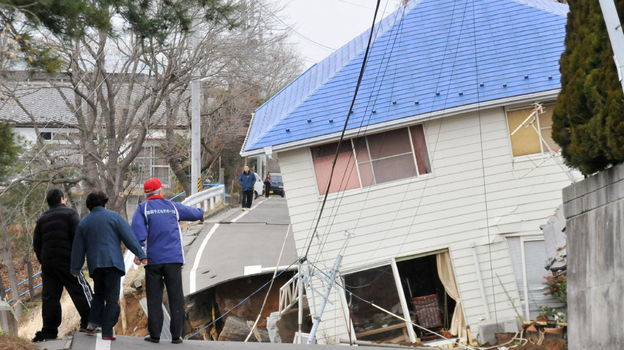
When Hurricane Katrina struck in 2005, one victim was political scientist Daniel Aldrich. He had just moved to New Orleans. Late one August night, there was a knock on the door.
"It was a neighbor who knew that we had no idea of the realities of the Gulf Coast life," said Aldrich, who is now a political scientist at Purdue University in Indiana. He "knocked on our door very late at night, around midnight on Saturday night, and said, 'Look, you've got small kids — you should really leave.' " The knock on the door was to prove prophetic. It changed the course of Aldrich's research and, in turn, is changing the way many experts now think about disaster preparedness.
Officials in New Orleans that Saturday night had not yet ordered an evacuation, but Aldrich trusted the neighbor who knocked on his door. He bundled his family into a car and drove to Houston. "Without that information we never would've left," Aldrich said. I think we would've been trapped."
In fact, by the time people were told to leave, it was too late and thousands of people got stuck.
Social Connections And Survival: Neighbors Matter
Because of his own experience in Katrina, Aldrich started thinking about how neighbors help one another during disasters. He decided to visit disaster sites around the world, looking for data. Aldrich's findings show that ambulances and firetrucks and government aid are not the principal ways most people survive during — and recover after — a disaster. His data suggest that while official help is useful — in clearing the water and getting the power back on in a place such as New Orleans after Katrina, for example — government interventions cannot bring neighborhoods back, and most emergency responders take far too long to get to the scene of a disaster to save many lives. Rather, it is the personal ties among members of a community that determine survival during a disaster, and recovery in its aftermath.
listen now or download Listen to the Story: All Things Considered
What Does Prayer Achieve?
If praying for someone else does them no good, what is the point of all those words and all that longing?

When I consider my Christian academic friends – people who are smarter, better read and harder working than I am – it's clear that Christianity is a very dangerous profession. Three have daughters who died in their 20s; another has a daughter who is a drug addict. Parents and spouses get Alzheimer's disease when they don't get cancer. I imagine they all prayed for these things not to happen. I know they all still pray.
So what is going on here? What is the point of all that prayer? This is hardly a new question. It has been around at least since Job. Nor is there any hope of finding an answer that will convince everyone. But it is possible to tease out a couple of questions. The first is whether intercessory prayer works better than chance. There aren't any reputable studies suggesting that it does, which is, I suppose another example of unanswered prayer, since at least some of these studies must have been commissioned in the hope that they would prove prayer is a worthwhile medical intervention.
I wouldn't be surprised, myself, if some forms of prayer worked a bit better than chance. Placebos do, after all. But it would be astonishing if it worked better than placebos. And they are not effective against most devastating diseases.
But since placebos don't work on third parties, that rather rules out the idea of praying for someone else's diseases, especially if they are an atheist, still more if they are a stranger. Almost the first study of the effects of intercessory prayer was conducted by Charles Darwin's cousin Francis Galton. This looked at the lifespans of the crowned heads of Victorian Europe, for whom prayers were said by almost all their subjects every week. Their lives were no longer than average.
Therese Borchard on Overcoming Depression

Therese Borchard writes about depression every day on her award-winning blog at Beliefnet.com. But it took a special leap of faith to share the stories of her breakdowns, hospitalizations and ongoing struggle with depression in her new book Beyond Blue: Surviving Depression & Anxiety and Making the Most of Bad Genes. "This will do wonders for my chances of future employment," she cracks. TIME writer Amy Sullivan talked with Borchard about the challenges of writing about mental illness (especially one's own) at the writer's home in Annapolis, Md.
The story you tell is very raw and can't have been easy to share. What made you decide to write this book?
I didn't write it for about 18 years because I thought that writing about your own life was self-indulgent. But then I thought about what kept me going through the darkest days, reading memoirs by other people who have struggled with depression — Kay Redfield Jamison, Anne Lamott — and who emerged even stronger and more capable.
When you're in the midst of depression, that's the scariest thing — it seems that you're going to feel like that forever. The pain created by depression kills almost 1 million people a year. It almost killed me, and it did kill my aunt. If I can give just one person hope that there's an end to depression, that it is treatable, then that made it worth it for me to write the book.
Have you reached the point where you feel that your depression is treatable?
I have. At first I was overmedicated by a psychiatrist — going through so many combinations of medications — and that made me very afraid of trusting psychiatrists and drugs. So I went from that extreme to doing everything holistically and hoping yoga, acupuncture and meditation would cure me. What I've found now is a happy medium between the two.
I wanted to ask you about your experience with psychiatrists because you really ran the gauntlet through multiple doctors before you found the right fit.
My psychiatrist told me it's usually 10 years before you find the right doctor and right medication, especially when you're bipolar like I am. That was true with me. I was exhibiting symptoms in college — and seeing a few psychiatrists — but it wasn't until 10 years
Senegal's Traditional Healers
Jori Lewis reports on traditional medicine in the West African nation of Senegal.


Traditional medicine is big business in the West African nation of Senegal. Critics say regulation is needed, while others say traditional healers are their only hope.
KATY CLARK: In many parts of Africa, when people get sick, there’s a good chance that they won’t go to the doctor for a visit or the pharmacist for a prescription. They’ll go to a traditional healer for some herbs or some prayers or a ceremony or two. They do it for lots of reasons: limited access to medical care, the prohibitive costs of Western medicines or because their spiritual beliefs tell them to. Jori Lewis reports from the West African nation Senegal where traditional medicine is big business.
JORI LEWIS: Rokhaya Pouye had been suffering from years. She couldn’t eat. She couldn’t walk. She couldn’t sleep. When her family took her to the hospital, the doctors couldn’t find anything wrong with her. So her family decided if it wasn’t the body, it had to be the spirit – or spirits, to be precise. Madame Pouye says she turned to traditional medicine. The spirits, she says, asked her to kill three oxen in a ten-day ceremony to protect herself from the sorcerers. She says she was healed by an ndeup ceremony. It’s a ritual that involves prayer, animal sacrifice and dance. And now she helps out at local ndeup ceremonies, like this one in a suburb of Dakar. The women of this extended family whirl, jump and fling themselves around a courtyard. They move to the drums until they feel the spirits taking over their bodies. One woman falls to the ground, tears running down her face. Another picks up a drummer and carries him around. He doesn’t miss a beat. It’s beautiful to watch. But is this medicine? Mamadou Ngom oversees the traditional medicine sector for the World Health Organization in Dakar. His answer is an emphatic yes.
NGOM: Yes, that’s traditional medicine. The problem that we have as scientists is that we are grounded in reason and scientific criteria. We say, "What are they doing?" But it’s something that they have done many times over many years, and they know they will get the same results.
listen now or download mp3 audio, 6 minutes
Can Positive Thoughts Help Heal Another Person?
Fourth of a five-part series
Ninety percent of Americans say they pray — for their health, or their love life or their final exams. But does prayer do any good?
For decades, scientists have tried to test the power of prayer and positive thinking, with mixed results. Now some scientists are fording new — and controversial — territory.
Mind Over Body
When I first meet Sheri Kaplan, she is perched on a plastic chair at a Miami clinic, holding out her arm as a researcher draws several vials of blood.
"I'm quite excited about my blood work this time," she says. "I've got no stress and I'm proud of it."
Kaplan is tanned and freckled, with wavy red hair and a cocky laugh. She is defiantly healthy for a person who has lived with HIV for the past 15 years.
"God didn't want me to die or even get sick," she asserts. "I've never had any opportunistic infections, because I had no time to be down."
Kaplan's faith is unorthodox, but it's central to her life. She was raised Jewish, and although she claims no formal religion now, she prays and meditates every day. She believes God is keeping the virus at bay and that her faith is the reason she's alive
- listen… [npr player, 8 minutes 26 seconds]
The God Chemical: Brain Chemistry and Mysticism
First of a five-part series
For much of the 20th century, mainstream science shied away from studying spirituality.
Sigmund Freud declared God to be a delusion, and others maintained that God, if there is such a thing, is beyond the tools of science to measure.
But now, some researchers are using new technologies to try to understand spiritual experience. They're peering into our brains and studying our bodies to look for circumstantial evidence of a spiritual world. The search is in its infancy, and scientists doubt they will ever be able to prove — or disprove — the existence of God.
Peyote Healing
The search for that answer led me to my first peyote ceremony, on a mountaintop on the Navajo reservation at Lukachukai, Ariz.
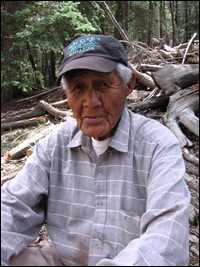
While Fred Harvey, an 87-year-old roadman, or high priest, warmed up his voice, members of his family prepared the peyote, a cactus that induces visions when ingested. Using peyote to touch the spiritual world has been central to the Navajo religion for hundreds of years.
Andy Harvey, a ceremony participant, said peyote serves as a mediator between the human world and the divine.
"Sometimes we ask the peyote to help us cleanse the illnesses away and cleanse our mental being, our spiritual being," he said. "And we believe that's what peyote does, too. That's why we call it a sacrament, a sacred herb."
I spent a year exploring the emerging science of spirituality for my book, Fingerprints of God. One of the questions raised by my reporting: Is an encounter with God merely a chemical reaction?
Peyote Healing
The search for that answer led me to my first peyote ceremony, on a mountaintop on the Navajo reservation at Lukachukai, Ariz.
While Fred Harvey, an 87-year-old roadman, or high priest, warmed up his voice, members of his family prepared the peyote, a cactus that induces visions when ingested. Using peyote to touch the spiritual world has been central to the Navajo religion for hundreds of years.
listen now or download All Things Considered
- listen… [npr player, 7 minutes 55 seconds]
Researchers Look at Prayer and Healing
Conclusions and Premises Debated as Big Study's Release Nears


At the Fairfax Community Church in Virginia, the faithful regularly pray for ailing strangers. Same goes at the Adas Israel synagogue in Washington and the Islamic Center of Maryland in Gaithersburg.
In churches, mosques, ashrams, "healing rooms," prayer groups and homes nationwide, millions of Americans offer prayers daily to heal themselves, family, friends, co-workers and even people found through the Internet. Fueled by the upsurge in religious expression in the United States, prayer is the most common complement to mainstream medicine, far outpacing acupuncture, herbs, vitamins and other alternative remedies.
"Judaism, Christianity, Islam, Buddhism—every religion believes in prayer for healing," said Paul Parker, a professor of theology and religion at Elmhurst College outside Chicago. "Some call it prayer, some call it cleansing the mind. The words or posture may vary. But in times of illness, all religions look towards their source of authority."
The outpouring of spiritual healing has inspired a small group of researchers to attempt to use the tools of modern science to test the power of prayer to cure others. The results have been mixed and highly controversial. Skeptics say ay the work is a deeply flawed and misguided waste of money that irresponsibly attempts to validate the supernatural with science. And some believers say it is pointless to try to divine the workings of with experiments devised by mortals.
Proponents, however, maintain the research is valuable, given the large numbers of people who believe in the power of prayer to influence health. Surveys have found that perhaps half of Americans regularly pray for their own health, and at least a quarter have others pray for them.