

 About the Fellowship
Society & Beliefs
Why We're All Fundamentalist
When did faith stop being about trust, and become a set of propositions to be believed? Mark Vernon looks back in history for clues to the fundamentals that fire a true life passion for people.

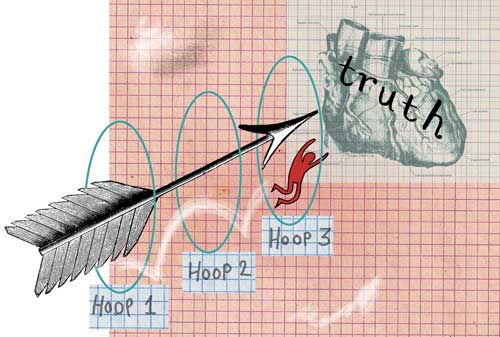
There is a story about Socrates, in which the sage of Athens is looking back on his life1. He recalls one day sitting with Plato, in the days of his great disciple's youth. Plato is talking. Socrates is watching him. He can see the freckles on Plato's face, his intelligent eyes, his seriousness, his confidence. Suddenly, Socrates is struck by a thought: 'I knew that if an archer were to shoot at him, I would step in front of him without hesitating and I'd take the arrow in my chest.' He knew this without a doubt. And then came a feeling that surprised him. 'I was smiling because I was truly happy.'
Human beings are all, in a sense, fundamentalists. Or at least, we might all hope to be so - an individual who knows who they would die for; what they would die for. It will be a person or belief so essential, so sacred, that sacrificing for it would not so much end your life as show your life has an end, in the sense of a goal, a reason, a meaning.
Further, knowing what you would die for means that you know what you live for. There is nothing that makes life more worth living; it generates purpose, commitment, love. It is liberating too. If you know you could let go of life, you can live more freely now. Socrates smiled. He was happy. Fundamentalism, though, is different. In its rarer, violent forms it is a basic conviction about life too, though gone wrong. Love reveals what you would die for. But the passions of hatred and war can do so too, as the jihadis learnt in the Afghan conflicts of the last decades of the 20th century. Further, this kind of fundamentalism is not so much about what you would die for as what you would kill for.
Is the Death Penalty in Keeping with Catholic Doctrine?

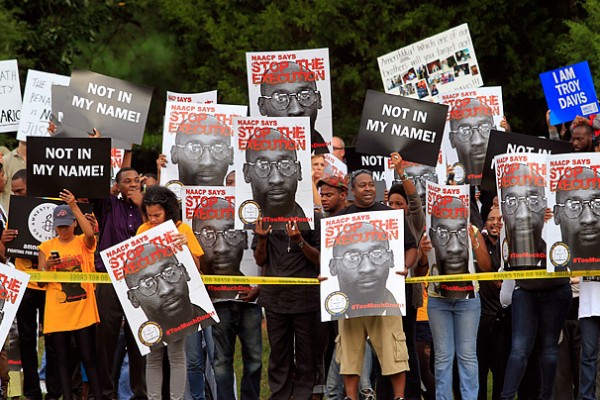
September has been execution season in the United States. In the past month, Texas executed two prisoners, Florida and Alabama each sent an inmate to the death chamber, and in Georgia, the controversial lethal injection of Troy Davis went forward despite last-minute consideration of his case by the U.S. Supreme Court. The justices did halt the scheduled executions of two other Texas inmates, and Republican Governor John Kasich commuted the death sentence of an Ohio prisoner.
The issue has even reentered the realm of presidential politics, after all but disappearing for several decades. In his first debate with fellow GOP contenders, Texas Rick Perry fielded a question about the record number of executions over which he has presided as governor (234 at the time of the debate, 236 now). "Have you struggled to sleep at night with the idea that any one of those might have been innocent?" asked moderator Brian Williams. "I’ve never struggled with that at all," was Perry’s response, delivered to an approving audience of conservatives who applauded the number of Texas executions.
But if Perry hasn’t struggled with the application of the death penalty, what about the Catholic justices who hold the power to stop a man’s execution or allow the state to kill him? Supreme Court Justice Antonin Scalia addressed that question earlier this week in a speech at a Catholic law school in Pittsburgh. "If I thought that Catholic doctrine held the death penalty to be immoral," said Scalia, "I would resign. I could not be a part of a system that imposes it."
Americans Tailor Religion to Fit Their Needs


If World War II-era warbler Kate Smith sang today, her anthem could be Gods Bless America. That's one of the key findings in newly released research that reveals America's drift from clearly defined religious denominations to faiths cut to fit personal preferences.
The folks who make up God as they go are side-by-side with self-proclaimed believers who claim the Christian label but shed their ties to traditional beliefs and practices. Religion statistics expert George Barna says, with a wry hint of exaggeration, America is headed for "310 million people with 310 million religions."
"We are a designer society. We want everything customized to our personal needs — our clothing, our food, our education," he says. Now it's our religion.
Barna's new book on U.S. Christians, Futurecast, tracks changes from 1991 to 2011, in annual national surveys of 1,000 to 1,600 U.S. adults. All the major trend lines of religious belief and behavior he measured ran downward — except two. More people claim they have accepted Jesus as their savior and expect to go to heaven.
And more say they haven't been to church in the past six months except for special occasions such as weddings or funerals. In 1991, 24% were "unchurched." Today, it's 37%. Barna blames pastors for those oddly contradictory findings. Everyone hears, "Jesus is the answer. Embrace him. Say this little Sinners Prayer and keep coming back. It doesn't work. People end up bored, burned out and empty," he says. "They look at church and wonder, 'Jesus died for this?'" The consequence, Barna says, is that, for every subgroup of religion, race, gender, age and region of the country, the important markers of religious connection are fracturing.
Pope Benedict XVI: British Riots Linked To 'Moral Relativism'


VATICAN CITY (RNS) Pope Benedict XVI linked last month's riots in England to the corrosive effects of "moral relativism," and warned that preserving social order requires government policies based on "enduring values."
Benedict made his remarks on Friday (Sept. 9) to Britain's new Vatican ambassador, Nigel M. Baker, at a meeting in the papal summer residence at Castel Gandolfo, outside Rome.
The moral basis of government policies is "especially important in the light of events in England this summer," Benedict said, in an apparent reference to riots in London and other English cities last month, which left five people dead and caused at least 200 million pounds ($320 million) in property damage.
"When policies do not presume or promote objective values, the resulting moral relativism ... tends instead to produce frustration, despair, selfishness and a disregard for the life and liberty of others," the pope said.
Benedict called on government leaders to foster the "essential values of a healthy society, through the defense of life and of the
family, the sound moral education of the young, and a fraternal regard for the poor and the weak."
The pope's words echoed remarks by British Prime Minister David Cameron, who said last month that the riots were a consequence of his nation's "slow-motion moral collapse."
What Journalists Should Be Asking Politicians About Religion
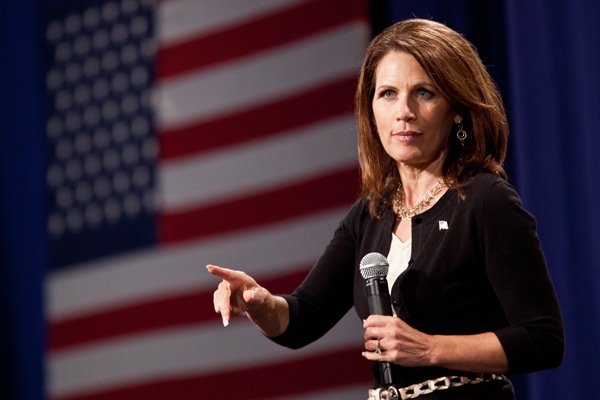
A few weeks ago, I opened up my Twitter feed early in the morning and immediately wondered if I was being punk’d. Instead of the usual horse race speculation, my colleagues in the political press corps were discussing the writings of evangelical theologian Francis Schaeffer and debating the definition of Dominionism. The same week, a conservative journalist had posed a question about submission theology in a GOP debate, and David Gregory had grilled Michele Bachmann about whether God would guide her decision-making if she became President.
The combination of religion and politics is a combustible one. And while I’m thrilled to see journalists taking on these topics, it seemed to me a few guidelines might be helpful in covering religion on the campaign trail:
Ask relevant questions.
The New York Times‘ Bill Keller published a column last weekend calling for journalists to ask candidates "tougher questions about faith" and posing a few of his own. The essay was flawed on its own terms. It read like a parody of an out-of-touch, secular, Manhattan journalist–comparing religious believers to people who believe in space aliens, and referring to evangelical Christian churches as "mysterious" and "suspect." But it also identified the wrong problem. It’s not necessarily tougher questions that are needed but more relevant questions than journalists normally pose. It’s tempting to get into whether a Catholic candidate takes communion or if an evangelical politician actually thinks she speaks to God. But if a candidate brings up his faith on the campaign trail, there are two main questions journalists need to ask: 1) Would your religious beliefs have any bearing on the actions you would take in office? and 2) If so, how?Values Added
Southern Baptist Edition

Amy Sullivan and Richard Land talk about Southern Baptists
Is the religious right dead? And is that a stupid question? (06:13)
Richard: Perry is Bush on steroids (02:24)
Why Southern Baptists hate Obamacare (02:40)
The Christian case for comprehensive immigration reform (08:31)
What do voters deserve to know about a politician’s faith? (07:20)
Questions for Obama about his Christian faith (03:23)
NYT Editor's Column on Religious Faith Sparks Firestorm


A New York Times column by outgoing Executive Editor Bill Keller has unleashed a hailstorm of online criticism among religious bloggers and conservative activists. The fact that the column compares religious believers to folks who think that space aliens are residing on Earth is just the beginning. Keller’s column, "Asking Candidates Tougher Questions About Faith," argues that the crop of candidates competing for the White House next year should be grilled on their religious beliefs and on how those beliefs inform their political views.
That’s especially true, Keller reasons, because many of this year’s GOP contenders hail from "churches that are mysterious or suspect to many Americans." Here’s Keller:
"Mitt Romney and Jon Huntsman are Mormons, a faith that many conservative Christians have been taught is a "cult" and that many others think is just weird. … Rick Perry and Michele Bachmann are both affiliated with fervid subsets of evangelical Christianity — and Rick Santorum comes out of the most conservative wing of Catholicism — which has raised concerns about their respect for the separation of church and state, not to mention the separation of fact and fiction."
One of the Timesman’s key concerns is that these candidates will put their religious faith first - above the national interest and the laws of the land:
"I do want to know if a candidate places fealty to the Bible, the Book of Mormon (the text, not the Broadway musical) or some other authority higher than the Constitution and laws of this country. … I care a lot if a candidate is going to be a Trojan horse for a sect that believes it has divine instructions on how we should be governed."
To that end, Keller announces that he has sent customized questionnaires to handful of Republican presidential candidates, with questions like, "Do you agree with those religious leaders who say that America is a "Christian nation" or a "Judeo-Christian nation?" and what does that mean in practice?"
We Can't Forgive, We Can Only Pretend To
Evolutionary doctrine teaches us that it's in our own self-interest to co-operate and to put up with others.


Forgiveness is impossible. This was the thought of the philosopher Jacques Derrida, and he has a good point.
There are some things that we say are easy to forgive. But, Derrida argues, they don't actually need forgiving. I forget to reply to an email, and my friend remarks: "Oh, it didn't really matter anyway." It's not that he forgave me. He'd forgotten about the email too.
Then, there are other things we say are hard to forgive, and we admire those who appear to be able to forgive nonetheless. The case of Rais Bhuiyan, who was shot by Mark Stroman, is a case in point. Bhuiyan says he forgave Stroman, and asked the Texas authorities not to execute him for his crime. But did Bhuiyan really forgive?
He writes of how Stroman was ignorant and had a terrible upbringing. He had seen signs that Stroman was now a changed man. So, it does not seem that Bhuiyan forgave his assailant. Rather, he came to understand him. He saw the crime from the perpetrator's point of view. There were reasons for the wrongdoing. That lets Stroman off the hook. It's not really forgiveness.
CS Lewis wrote: "Everyone says forgiveness is a lovely idea, until they have something to forgive." Which is again to imply that those who think they have offered forgiveness really find they don't have anything to forgive after all.
The ancient philosophers appear to have thought that forgiveness is something of a pseudo-subject, too. They hardly touched on it, for all that they dwelt on all manner of other moral concerns. It is not on any list of virtues. Take Aristotle. He wrote about pardoning people, but only when they are not responsible. "There is pardon," he says, "whenever someone does a wrong action because of conditions of a sort that overstrain human nature, and that no one would endure." When nature has not been overstrained, justice must meet wrongdoing. Forgiveness doesn't come into it.
All this calls into question a theory in evolutionary psychology. Here, the argument is that forgiveness is essential to our evolutionary success. It's because we forgive one another that we are able to live in large groups. People in collectives like cities are bound to offend one another all the time, the theory goes. It's because we are so ready to forgive and continue to co-operate that we don't, as a rule, destroy ourselves in spirals of retribution.
Explain it to me: Ramadan
No food? No drinking? No sex? It's the Muslim month of Ramadan. CNN Religion Editor Dan Gilgoff explains.
Carl Jung, Part 8: Religion and the search for meaning
Jung thought psychology could offer a language for grappling with moral ambiguities in an age of spiritual crisis.

In 1959, two years before his death, Jung was interviewed for the BBC television programme Face to Face. The presenter, John Freeman, asked the elderly sage if he now believed in God. "Now?" Jung replied, paused and smiled. "Difficult to answer. I know. I don't need to believe, I know."
What did he mean? Perhaps several things.
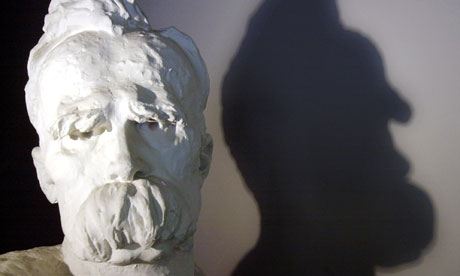
He had spent much of the second half of his life exploring what it is to live during a period of spiritual crisis. It is manifest in the widespread search for meaning – a peculiar characteristic of the modern age: our medieval and ancient forebears showed few signs of it, if anything suffering from an excess of meaning. The crisis stems from the cultural convulsion triggered by the decline of religion in Europe. "Are we not plunging continually," Nietzsche has the "madman" ask when he announces the death of God. "Is not the greatness of this deed too great for us?"
Jung read Nietzsche and agreed that it was. The slaughter of two world wars and, as if that were not enough, the subsequent proliferation of nuclear weaponry were signs of a civilisation swept along by unconscious tides that religion, like a network of dykes, once helped contain. "A secret unrest gnaws at the roots of our being," he wrote, an unrest that yearns for the divine. Nietzsche agreed that God still existed as a psychic reality too: "We godless anti-metaphysicians still take our fire … from the flame lit by a faith that is thousands of years old." And now the flame is out of control.
The sense of threat – real and imagined – that Jung witnessed during his lifetime has not lessened. Ecologists such as James Lovelock now predict that the planet itself has turned against us. Or think of the war games that power an online gaming industry worth £45bn and counting. Why do so many spend so much indulging murderous fantasies?
You could also point to the proliferation of new age spiritualities that take on increasingly fantastical forms. One that interested Jung was UFOs: the longing for aliens – we are without God but not without cosmic companions – coupled to tales of being "chosen" for abduction, are indicative of mass spiritual hunger.
Italy's Family Ties
Rome's austerity package threatens the country's traditional social structure.


Today the Italian parliament will vote on an austerity package designed to reduce its budget by roughly €40 billion over the next three years. The move comes under pressure from international bond markets, whose fears about government debt in wake of the Greek debacle have threatened to provoke a crisis in the euro zone's third largest economy.
While the most politically controversial proposals aren't unique to the Italian austerity plan, cuts in pensions and increased medical fees, one provision points to a long-term social change that is dramatically transforming Italy's economy.
Part of the package places a new tax on Italian divorces. There would be a €37 fee for every uncontested dissolution, which increases to €85 whenever a judge must settle disagreements over property or custody. Just a few years ago, this levy would have brought in a trivial amount of revenue. In 1995, there were only 80 divorces for every 1,000 marriages in Italy. In 2009, that number reached 181 and is still on the rise. Government estimates suggest that the tax will bring in €10.5 million in its first three years.
Italians will pay for divorce in more than taxes. The decline of the traditional family will mean the disappearance of their greatest social service provider. Even at the height of its postwar largesse, the Italian welfare state never matched the cradle-to-grave care of northern European countries. Anyone who has used Italian public services knows that they are usually inadequate without any contributions (financial or in-kind) from relatives.
According to Francesco Billari, a professor of demography at Milan's Bocconi University, some 30% of Italian grandparents provide day care for at least one grandchild. On average, this is a far higher share than in other Western European countries, which spend 40% more than Italy on these types of services.
Carl Jung, Part 6: Synchronicity
With physicist Wolfgang Pauli, Jung explored the link between the disparate realities of matter and mind.
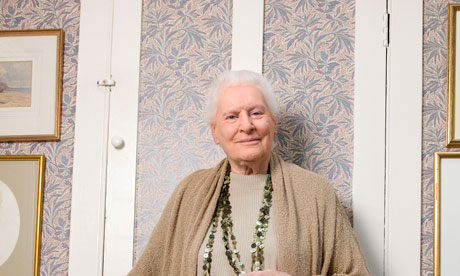
The literary agent and author Diana Athill describes the genesis of one of her short stories. It occurred about nine one morning, when she was walking her dog. Crossing the road, a car approached and slowed down. She presumed someone needed directions. A man leaned out and brazenly asked her whether she would like to join him for coffee.
That was odd enough, so early in the day. More oddly still, the man powerfully reminded her of someone else. He looked just like a lost friend and, further, the daring approach was just the kind of thing her friend would have done. She couldn't stop thinking about the coincidence. It left her feeling " energised and strange," a flow that kept bubbling up until she channelled it, producing the short story.
It is an example of what Jung called synchronicity, "a coincidence in time of two or more causally unrelated events which have the same or similar meaning" – in Athill's case, the surprising invitation of the man and his looking like her friend. Anecdotally, it seems that such experiences are familiar to many. They are undoubtedly meaningful and produce tangible effects too, like short stories. But they raise a question: is the relationship between the events random or is some hidden force actively at work? Jung pursued this question in an odd relationship of his own, with one of the great physicists of the 20th century, Wolfgang Pauli. The story of their friendship is related by Arthur I Miller, in "137: Jung, Pauli, and the Pursuit of a Scientific Obsession."
Pauli was a Jekyll and Hyde character, a Nobel theorist by day and sometime drunk womaniser by night. He turned to Jung when he could no longer hold the competing aspects of his life together. Jung was always fascinated by personality splits, and his analysis helped to steady Pauli. They began working together in a collaboration that lasted for several decades, though mostly behind closed doors: Pauli worried for his reputation, though eventually they published a book together.
Presidential Race and Religion


The first of the blockade-busting flotilla of boats bound for Gaza has set off; there are fears of a repeat of the violence last year which led to the death of nine protesters. The BBC's Yolande Knell describes the mood in Jerusalem.
Two weeks ago, we joined Symon Hill as he set off on a walk of repentance from Birmingham to London. Symon finishes his walk this weekend and he will tell William about his journey.
Files have revealed that a Christian socialist group, which had the future Archbishop of Canterbury as one of its members, was being watched by MI5 and was called 'the most subversive group in the Church'. William finds out more about it with two of the group's former members.
The race for the Republican Presidential nomination is hotting up, and the religion of the two front runners is playing a big factor. William speaks to US political analyst Mark Pinsky and author Tricia Erickson.
What effect has one posting on YouTube of a female had on the role of women in the strict kingdom of Saudi Arabia? We'll hear from women's rights activist Hala Al Dosari.
listen now or download Listen now: Radio 4
CNN Accurately Explains Beliefs and Misconceptions of LDS Church
Misconceptions about Mormons were cleared up accurately, but not by The Church of Jesus Christ of Latter-day Saints.
Dan Gilgoff, CNN's religion editor, posted a video called "Explain it to me: Mormonism." The video covers basic Mormon beliefs, but mostly focuses on common misconceptions on topics like polygamy.
"Ever since 1890, the official Mormon Church has banned polygamy," Gilgoff said. "Polygamists in the church today are actually excommunicated from the church."
He goes on to explain the FLDS is a "breakaway sect that continues to practice polygamy to this day."
Gilgoff runs down a list of basic LDS beliefs, including its beginnings in 1830, the translation of The Book of Mormon, the physical characteristics of God, continuing revelation and the eternal perpetuation of the family.
He specifically focuses on the missionary work of the church. He points out that Mitt Romney and Jon Huntsman Jr. have served missions.
"For Huntsman, he was assigned to Taiwan as a missionary, and it helped him acquire the Chinese language skills, which later helped him land the job as President Obama's ambassador to China," Gilgoff said.
He claims the LDS Church has a "tradition or an image of being seen as a very white-bread church," but the church is working hard to move away from that. He references Mormon.org, the church's missionary outreach website, which shows Mormons from different ethnic backgrounds.
The Dalai Lama, Marxist?
The brave spiritual leader's unusual blind spot.
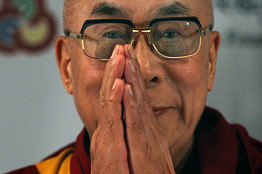
Earlier this month, the Dalai Lama told a group of Chinese students at the University of Minnesota, "I consider myself a Marxist . . . but not a Leninist." The comment struck some as odd—as if Lindsey Lohan had declared herself a Shaker. Students in the audience looked puzzled. One blogger wondered "if Pope Benedict and other world religious leaders are soon to follow."
But those who have followed His Holiness Tenzin Gyatso, the 14th Dalai Lama, know that he regularly trots out a Marxist banner. When he came to Radio City Music Hall to lecture for a few days last year, he announced "Still I am a Marxist" even while thanking his good friends in the Chinese Communist Party for bringing capitalist freedoms to their land.
That stance leads to some head-scratching. Isn't this esteemed 75-year-old Nobel Peace Laureate the former "Boy King" who fled Mao's Chinese forces in 1959? Isn't he the 50-year exile whose fellow Tibetans suffered genocide, after some 20% of them died at the hands of Chinese forces or from starvation? Isn't Marxism a godless secular thing, and the Dalai Lama himself a manifestation of God on earth? If he doesn't know Marxism is false, who does?
The Dalai Lama explained his youthful enthusiasm in a 1999 essay for Time, mentioning that he even considered joining the Communist Party: "Tibet at that time was very, very backward. The ruling class did not seem to care, and there was much inequality. Marxism talked about an equal and just distribution of wealth. I was very much in favor of this. Then there was the concept of self-creation. Marxism talked about self-reliance, without depending on a creator or a God. That was very attractive. . . . I still think that if a genuine communist movement had come to Tibet, there would have been much benefit to the people."
It's an old, familiar position in Western secular intellectual life: Marxism wasn't a God that failed, and the Soviet Union and Mao's China don't count against it, because Marxism was never tried—Communism perverted it. The problem is that Marx wasn't just a Marxist—he was a Communist—and many of Mao's most destructive moves came right out of Marx's playbook for destroying self-reliance, among other things.
Ten Things the BeliefBlog Learned in its First Year


In case you were wondering about all the balloons and cake: CNN’s Belief Blog has just marked its first birthday.
After publishing 1,840 posts and sifting through 452,603 comments (OK, we may have missed one or two) the Belief Blog feels older than its 12 months would suggest. But it also feels wiser, having followed the faith angles of big news stories, commissioned lots of commentary and, yes, paid attention to all those reader comments for a solid year.
10 things we've learned:
1. Every big news story has a faith angle.
Even the ordeal of 33 Chilean miners trapped underground for more than two months. Even the attempted assassination of Arizona congresswoman Gabby Giffords. Even March Madness . Even – well, you get the point.
2. Atheists are the most fervent commenters on matters religious.
This became apparent immediately after the Belief Blog's first official post last May, which quickly drew such comments as:Values Added
It's the Religion, Stupid
Amy Sullivan and Melinda Henneberger chat about religion.
Values Added: It’s the Religion, Stupid
Just how Mormon is Jon Huntsman? (08:21)
"Big Love" and the mainstreaming of Mormonism (05:31)
The real meaning of "Obama is a Muslim" (09:53)
Family values face-off: Bachmann vs. Palin (03:11)
The anti-Boehner protest at Catholic University (11:43)
Setting the record straight on Paul Ryan and Archbishop Dolan (08:01)
In Search of Happily Ever After

When Indian steel tycoon Pramod Agarwal married off his daughter Vinita in Venice last weekend, the entertainment included stilt-walkers, fireworks, two Indian elephants and a 45-minute private concert by the Colombian pop star Shakira. Reports in the Italian press (which, it must be said, tends to err on the side of hyperbole) put the cost of the three-day affair as high as €20 million.
Few of the 10,000 foreign couples expected to marry in Italy this year are likely to rival the Agarwal nuptials for lavishness. Yet if past trends continue, these "destination" weddings will enrich the national economy by at least €180 million—not counting airfare and post-celebration spending by the newlyweds and their guests.
These figures come from Paolo Nassi, general manager of the Regency Travel Group, which has organized weddings of foreigners in Italy since 1987. Destination weddings are a business that has defied recent downturns in the wider tourism industry, Mr. Nassi says. The annual number of such events here has more than doubled since the beginning of the century, compared with the previous decade.
It's not just that getting married is something that ideally happens only once, and thus an unlikely candidate for the budget-cutter's axe. Getting married abroad can actually be an economical move, since it normally means entertaining fewer guests than at a reception thrown back home. Mr. Nassi says that saving money is the single most common reason his clients give for coming to Italy to wed. Choosing to spend on a honeymoon instead of a big party might seem flagrantly un-Italian. Weddings here, especially in the south, are traditionally proud displays of a family's prosperity (or willingness to take on debt), with a guest list that amounts to an exhaustive roster of one's clan and social network. But that costly custom has spawned a no-less-characteristically Italian tradition known in Sicilian dialect as the fuitina: an elopement, supposedly undertaken to defy the opposition of the couple's families, but often planned with their tacit agreement to spare the expense of a wedding. In that case, the only extravagance on view is the in-laws' show of feigned outrage.
Vatican Opens Dialogue With Atheists

VATICAN CITY (RNS) A new Vatican initiative to promote dialogue between believers and atheists debuted with a two-day event on Thursday and Friday (March 24-25) in Paris.
"Religion, Light and Common Reason" was the theme of seminars sponsored by the Vatican's Pontifical Council for Culture at various locations in the French capital, including Paris-Sorbonne University and the United Nations Educational, Scientific and Cultural Organization (UNESCO).
"The church does not see itself as an island cut off from the world ... Dialogue is thus a question of principle for her," Cardinal Gianfranco Ravasi told the French newspaper La Croix. "We are aware that the great challenge is not atheism but indifference, which is much more dangerous."
The events were scheduled to conclude with a party for youth in the courtyard of the Cathedral of Notre Dame on Friday evening (March 25), featuring an appearance via video by Pope Benedict XVI, followed by prayer and meditation inside the cathedral.
The initiative, called "Courtyard of the Gentiles," takes its name from a section of the ancient Temple of Jerusalem accessible to non-Jews, which Benedict has used as a metaphor for dialogue between Catholics and non-believers.
Buddhism is the New Opium of the People
Western Buddhism has a long path to travel before becoming something that resists, rather than supplements, consumerism.

In one of the many living rooms that belong to David and Victoria Beckham, there sits a four-feet-high golden statue of the Buddha. Madeleine Bunting spotted it on TV, she told a packed audience for the last of the Uncertain Minds series. What is it about Buddhism, she mused, that makes it such a perfect fit with modern consumerism?
The Buddhist writer Stephen Batchelor who, along with the Buddhist scholar John Peacock, was speaking at the event, replied that there is a temple in Thailand that contains a Buddha rendered as a small image of David Beckham. The symmetry is perfect. And it raises a vital question for western Buddhism.
Western Buddhism presents itself as a remedy against the stresses of modern life though, as Slavoj Žižek has noted, it actually functions as a perfect supplement to modern life. It allows adherents to decouple from the stress, whilst leaving the causes of the stress intact: consumptive forces continue unhindered along their creatively destructive path. In short, Buddhism is the new opium of the people.
Batchelor and Peacock might agree that this is a serious charge and grave risk. And their efforts can be interpreted as precisely to resist it.
Their analysis is different. Western Buddhism is undergoing its Protestant reformation, Batchelor observed. It is about two centuries behind western Christianity in terms of its critical engagement with its canonical texts. The quest for the historical Buddha – an exercise that parallels the 19th-century quest for the historical Jesus – is only just under way. An essentially medieval Buddhism has been catapulted into modernity. It's hardly surprising that it will take two, perhaps three centuries for an authentically western form to emerge – by which is meant, in part, one that resists, not supplements, consumerism. For if Buddhism is to live in the modern world, it must be treated as a living tradition, not a preformed import. As the reformation leaders of the 16th century knew, this is a profoundly unsettling project – though it is also compelling for its promise is new life.
How Japan’s Religions Confront Tragedy

Proud of their secular society, most Japanese aren't religious in the way Americans are: They tend not to identify with a single tradition nor study religious texts.
"The average Japanese person doesn’t consciously turn to Buddhism until there’s a funeral," says Brian Bocking, an expert in Japanese religions at Ireland’s University College Cork.
When there is a funeral, though, Japanese religious engagement tends to be pretty intense.
"A very large number of Japanese people believe that what they do for their ancestors after death matters, which might not be what we expect from a secular society," says Bocking. "There’s widespread belief in the presence of ancestors’ spirits."
In the days and weeks ahead, huge numbers of Japanese will be turning to their country’s religious traditions as they mourn the thousands of dead and try to muster the strength and resources to rebuild amid the massive destruction wrought by last Friday's 9.0 magnitude earthquake and resulting tsunami.
For most Japanese, religion is more complex than adhering to the country’s ancient Buddhist tradition. They blend Buddhist beliefs and customs with the country’s ancient Shinto tradition, which was formalized around the 15th century.
"Japanese are not religious in the way that people in North America are religious," says John Nelson, chair of theology and religious studies at the University of San Francisco. "They’ll move back and forth between two or more religious traditions, seeing them as tools that are appropriate for certain situations."
"For things connected to life-affirming events, they’ll turn to Shinto-style rituals or understandings," Nelson says. "But in connection to tragedy or suffering, it’s Buddhism."
There are many schools of Japanese Buddhism, each with its own teachings about suffering and what happens after death.
Pope Benedict Beatifies His Star Predecessor
The current pontiff lacks the presence and popularity of John Paul II, the former actor and Cold Warrior.

When Pope Benedict XVI declares Pope John Paul II "blessed" on May 1, bestowing on his predecessor the Catholic Church's highest honor short of sainthood, millions will watch from St. Peter's Square, on television and on the Internet. John Paul's beatification, which was officially announced last week, will be an occasion for recalling his eventful reign, and it will inevitably inspire comparisons with the man who now sits in his place. In many eyes, those comparisons will not prove favorable to Benedict.
The current pope is low-key, as Americans discovered during his 2008 visit. For all his charm, he lacks the gregariousness, physical presence and gift for the dramatic gesture with which the former actor John Paul could win over crowds.
Although a clearer and more accessible writer than John Paul, Benedict is far less at home in the age of electronic communications. His reign has been marked by a chain of public-relations disasters, most recently the widespread confusion over his remarks about the morality of condom use.
John Paul was also a much more commanding leader than his successor. It is impossible to imagine the late pope giving an interview of the kind that Benedict granted the German journalist Peter Seewald last year, in which he repeatedly admitted personal error and suggested that he is largely impotent to enforce many of his own policies within the church.
Nor has Benedict matched his predecessor's popularity among non-Catholics. An enthusiastic participant in inter-religious dialogue of all kinds, John Paul appealed to Muslims and Jews with historic apologies for Christian anti-Semitism and the sins of Catholics during the Inquisition and the Crusades.
The current papacy has been marked by heightened tensions with Muslims and Jews. Benedict's 2006 address in Regensburg, Germany, in which he quoted a medieval description of the teachings of Islam's prophet Muhammad as "evil and inhuman," was followed by violent protests in several Muslim countries. Benedict has also irritated Jews by readmitting an ultra-traditionalist bishop who turned out to be a Holocaust denier, and by honoring Pope Pius XII, who critics say failed to do or say enough against the Nazi genocide.
How a Marxist Might See the Creed
My take on Terry Eagleton's interpretation of Christianity unites it with Marxism in a rejection of progress.
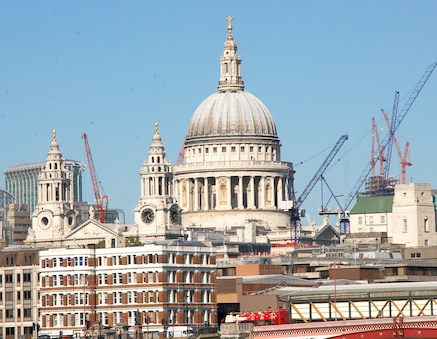
For the latest event in the Uncertain Minds series, I talked with the Marxist critic Terry Eagleton, author of Reason, Faith, and Revolution: Reflections on the God Debate. We were sitting beneath the stone arches of the Wren suite, in the crypt of St Paul's Cathedral. And as we conversed, I had a very odd experience. It was as if I could hear him reciting a Christian creed – sotto voce – adding in his distinctive gloss on several of the key phrases. Here's something close to what I imagined he said.
I believe in God. Obviously, if I were a Christian, I wouldn't believe in God in the way that an alarming proportion of Americans believe in alien abduction. After all, Satan believes in God in that sense. He knows God exists. But he doesn't trust in God and isn't committed to God's ways. Quite the opposite. Alain Badiou, probably the greatest philosopher alive today, writes about having a commitment to a revelatory event. That must be more like what a Christian believes.
Creator of heaven and earth. This, of course, has absolutely nothing to do with the big bang. Those who are tempted to think of it as a reference to divine pyrotechnics on a cosmic scale should read a little Wittgenstein. Creator-talk is theology, and that's a different language game from science. Rather, to call God the creator means that you believe the universe has a purpose. As to how it was done – physics has a few ideas. As to what that purpose might be – well, we perhaps glean something from the next line.
I believe in Jesus Christ. Jesus is the locus for a remarkable set of stories. They are remarkable because they remember a life that clung to faith even when the subject of that life was hanging half dead from a tree. As my sometime fellow papist Marxist, Herbert McCabe, once put it: if you don't love you die, if you do love they kill you. In this tragic world of ours, that seems to me to be quite true. And remember, tragedy is not the same as pessimism because pessimism gives up hope, which is precisely what Jesus didn't do. Though he had more reason than most to do so.
Army's 'Spiritual Fitness' Test Angers Some Soldiers


Multiple tours in Iraq and Afghanistan have taken a toll on soldiers: Witness the rise in suicides and other stress-related disorders. A few years ago, the Army noticed that some soldiers fared better than others, and it wondered: Why?
One reason, says Brig. Gen. Rhonda Cornum, is that people who are inclined toward spirituality seem to be more resilient.
"Researchers have found that spiritual people have decreased odds of attempting suicide, and that spiritual fitness has a positive impact on quality of life, on coping and on mental health," says Cornum, who is director of Comprehensive Soldier Fitness.
'Foxhole Atheist' Upset
Working with psychological researchers, the Army developed a survey to assess a soldier's family relationships and his well-being — emotionally, socially and spiritually. Every soldier was required to take the survey, including Justin Griffith, a sergeant at Fort Bragg, N.C.
Griffith, who describes himself as a "foxhole atheist," says he grew angry as the computerized survey asked him to rank himself on statements such as: "I am a spiritual person. I believe that in some way my life is closely connected to all of humanity. I often find comfort in my religion and spiritual beliefs."
"The next question was equally shocking," Griffith says. " 'In difficult times, I pray or meditate.' I don't do those things, and I don't think any of those questions have anything to do with how fit I am as a soldier."
Griffith finished the survey, pressed submit, and in a few moments, he received an assessment: "Spiritual fitness may be an area of difficulty."
listen now or download Listen to the Story: All Things Considered
11 Faith-Based Predictions for 2011

To open 2011, CNN's Belief Blog asked 10 religious leaders and experts - plus one secular humanist - to make a faith-based prediction about the year ahead.
Have a faithy prediction of your own? Share it in comments.
Here's what those in the know are predicting:
1. With the repeal of "don't ask, don't tell" there will be a more concerted effort by the gay, lesbian, bisexual and transgendered community for gay marriage, uniting conservative evangelicals, Roman Catholics, Muslims and Orthodox Jews in a much more civil but principled resistance. Respectful debate will produce more precise and pluralistic solutions.
–Dr. Joel C. Hunter, senior pastor of Northland, a Church Distributed, in Orlando, Florida
2. A new generation of Muslims will bust out of their culturally and politically isolated cocoons and passionately reclaim their voice and narratives; one that has been stolen, used, abused and hijacked by extremists, terrorists and fear-mongering propagandists. Watch out for a major cultural renaissance as a new generation of Muslim artists and storytellers grab the mic, enter the arena and speak their voice with a revived passion and purpose.
–Wajahat Ali, Muslim playwright and attorney
3. As anti-Christian violence accelerates in places like Iraq, Egypt and India, a government crackdown on Christian churches gathers steam in China, and European bureaucrats continue to drive Christianity from the public square, "Christianophobia" will become a buzzword.
–John Allen Jr., CNN's senior Vatican analyst
4. After years of increasingly contentious debates and billboard wars between religious believers and atheists, American secularists will begin to embrace a message of positive humanist community, gaining increasing acceptance as they organize cooperation between nontheists and theists toward the common good.
–Greg M. Epstein, humanist chaplain at Harvard University in Cambridge, Massachusetts
5. As religious tensions grow over the coming presidential election and domestic cultural issues involving perceived legislation of morality, the media will find more zealous Christians reacting to the issues of the day whose extreme positions will further divide the evangelical church into radical positions, and turn away seekers looking for a peaceful resolution to the churning in their own souls. In other words, the devil will play a trick on the church, and the church will, like sheep, lose their focus on the grace and love of Christ and wander astray. Those who seek peace, then, will turn to liberal ideologies.
–Don Miller, Christian author whose books include "Blue Like Jazz"
Walking Santa, Talking Christ
Why do Americans claim to be more religious than they are?

Two in five Americans say they regularly attend religious services. Upward of 90 percent of all Americans believe in God, pollsters report, and more than 70 percent have absolutely no doubt that God exists. The patron saint of Christmas, Americans insist, is the emaciated hero on the Cross, not the obese fellow in the overstuffed costume.
There is only one conclusion to draw from these numbers: Americans are significantly more religious than the citizens of other industrialized nations.
Except they are not.
Beyond the polls, social scientists have conducted more rigorous analyses of religious behavior. Rather than ask people how often they attend church, the better studies measure what people actually do. The results are surprising. Americans are hardly more religious than people living in other industrialized countries. Yet they consistently—and more or less uniquely—want others to believe they are more religious than they really are.
Religion in America seems tied up with questions of identity in ways that are not the case in other industrialized countries. When you ask Americans about their religious beliefs, it's like asking them whether they are good people, or asking whether they are patriots. They'll say yes, even if they cheated on their taxes, bilked Medicare for unnecessary services, and evaded the draft. Asking people how often they attend church elicits answers about their identity—who people think they are or feel they ought to be, rather than what they actually believe and do.
The better studies ascertain whether people attend church, not what they feel in their hearts. It's possible that many Americans are deeply religious but don't attend church (even as they claim they do). But if the data raise serious questions about self-reported church attendance, they ought to raise red flags about all aspects of self-reported religiosity. Besides, self-reported church attendance has been held up as proof that America has somehow resisted the secularizing trends that have swept other industrialized nations. What if those numbers are spectacularly wrong?
To the data: There was an obvious clue (in hindsight) that the survey numbers were hugely inflated. Even as pundits theorized about why Americans were so much more religious than Europeans, quiet voices on the ground asked how, if so many Americans were attending services, the pews of so many churches could be deserted.
"If Americans are going to church at the rate they report, the churches would be full on Sunday mornings and denominations would be growing," wrote C. Kirk Hadaway, now director of research at the Episcopal Church. (Hadaway's research has included evangelical congregations, which reported sharp growth in recent decades.)
All-American Grace

More than 20 years ago, an elderly, foreign-born Catholic priest told me, "You can't imagine how different it was here when I first came here in the '60s. Catholics and Protestants didn't really talk to each other. It's so much better now."
He was talking about clerics, mostly, but it was still startling news to me. I was born in the late '60s, around the time this priest moved to town. Sure, we Protestants had our suspicions about what Catholics really believed, but to keep them at a social distance? People really did that once? It was about as bizarre to folks of my generation as the thought that blacks and whites were once segregated by law. A year after my conversation with the old priest, I joined a parish class of inquirers seeking conversion to Catholicism, but left angry and discouraged after three months of regular meetings. We'd had lots of guided meditation and feel-good talks, but no doctrine, no substance, nothing solid.
I complained to a Catholic friend that all of us were going to become Catholics at Easter, but only those of us who had educated ourselves with outside reading were going to have the slightest idea what being a Catholic required of us. My sympathetic friend gave me the number of a crusty old Irish priest who had been stored away in a small inner-city parish.
"By the time I get through with you," said Father Moloney, in his chewy Irish brogue, "you might not want to be a Catholic, but you'll know what a Catholic is." I knew then that I was in good hands. That old-school priest grasped that Catholicism made various exclusive truth claims, and that it was important for potential converts to understand what they were assenting to before conversion. The priest at the other parish only seemed to care that his convert class have good feelings about being Catholic.
Those two anecdotes illustrate both the good news and the bad news in American Grace, the indispensable new portrait of U.S. religious life drawn by Harvard's Robert D. Putnam and Notre Dame's David E. Campbell, two of the nation's leading social scientists. The good news is that we Americans of different faith traditions get along remarkably well, not by casting aside religion, but by learning how to be tolerant even as we remain religiously engaged.
The bad news is that achieving religious comity has come at the price of religious particularity and theological competence. That is, we may still consider ourselves devoted to our faith, but increasingly, we don't know what our professed faith teaches, and we don't appreciate why that sort of thing is important in the first place.
William James and Agnosticism
Just how far will it get us if we resolve never to act beyond what the evidence allows?

Brian Zamulinski provided a long and thoughtful response to William James's case for jumping ahead of the evidence. He argued firstly that "Overbelief" can cause tremendous harm to others, as it did in Stalin's Russia, and secondly that we cannot know in advance how much harm will be caused to others by any belief unjustified by the evidence. It would follow that the only safe course is to avoid altogether believing beyond what the evidence allows.
Now the stipulation that overbelief is to be shunned because it can cause harm to others, rather than to the person who believes ahead of the evidence, is a shrewd and subtle attempt to rescue the Clifford position, and to shift it away from James' criticisms.
After all, no one who believes in an evolutionary account of religion can seriously suppose that overbelief has in the past caused more harm than "underbelief": waiting to act until the evidence is irresistible. If you believe, as I do, that we have an overdeveloped agency detection system that enables us to apprehend life and purpose where there is none, and that this is a product of evolution, this is pretty irrefutable evidence that waiting to see if that rustle in the grass really was a tiger was more harmful than jumping to conclusions and into the nearest tree. No doubt this was harmful to those more evidence-based hominids who waited to be certain that the rustling was a tiger, but it was good for our ancestors, who jumped.
The kind of harm that Zamulinski argues against is much more directly caused by overbelievers. To believe in the triumph of "scientific socialism", no matter what real science said, did kill tens of millions of people. In fact the history of Stalinism provides a paradigm case for evidence-based caution – at least among Western intellectuals. The people we admire in their response to Stalinism are the ones who refused to be taken in: Bertrand Russell, Orwell, Koestler, even Muggeridge, who all modified their initial romantic expectations in the light of experience and stuck to the truth of their disillusionment whatever the subsequent persecutions.
Two Views of Likely Catholic Leader

The U.S. Conference of Catholic Bishops gathers in Baltimore this week to decide who will be its next president, and if past is prologue, we know who will win: Bishop Gerald Kicanas of Tucson, Ariz. But this year, what is usually a rote decision is garnering a flurry of debate.
Kicanus is seen as an easygoing diplomat who prefers digging into policy papers over hogging the spotlight. And he's popular.
"In his diocese, he's seen as one of the most effective bishops in the country," says Rocco Palmo, a close observer of the Catholic Church, who writes the blog "Whispers in the Loggia".
Palmo says Kicanas earned that reputation after 2003, when he became bishop of Tucson, where he inherited a diocese rife with sex abuse allegations and on the brink of bankruptcy.
"While some dioceses have struggled — and it's been an acrimonious time — the Tucson bankruptcy under Kicanas' leadership has been seen as a national model," Palmo says.
The bankruptcy judge publicly praised Kicanas for treating the victims well spiritually and financially, Palmo says, and in a vote of confidence, donations to the bishop's appeal outstripped their expectations a year after the bankruptcy.
That's one view of Kicanas. Another is held by Terry McKiernan, who runs the watchdog group BishopsAccountability.org and says practically every bishop in the pipeline for the presidency has been tainted by the sex abuse scandal.
listen now or download NPR Morning Edition
Values Added: The Praying Field
Amy: Democrats foolishly conceded the faith vote (05:02)
When pastors say you can’t be a Democrat and a good Christian (06:11)
Does Tom Perriello’s narrow loss point the way forward? (07:18)
Oklahomans vote against the looming scourge of Shariah law (05:50)
The growing idea that Islam isn’t a real religion (03:24)
Glenn Beck, Pamela Geller, and innovations in hatred (11:47)
The Postmodern Condition: The Assault on Truth from Left to Right (video)

Vancouver Sun columnist Peter McKnight looks at how postmodernism - a left wing theory that promotes skepticism of truth - is now being championed by those on the right.
Hitchens Brothers Agree To Disagree Over God

JJournalist Christopher Hitchens is one of the world's most famous atheists. His brother, Peter, insists that a civilized world must believe in God. The brothers have publicly argued over faith for years. But now that Christopher Hitchens has been diagnosed with cancer, the theoretical argument has become real. Just how real was apparent at the Pew Forum on Religion and Public Life, where the brothers were having a public conversation about God. Christopher Hitchens often wears a white straw hat. He says his head, completely bald from chemotherapy treatments, gets cold. He's tired. He's thin. He's off his food.
But ask Hitchens, author of "God Is Not Great," if having cancer has changed his view of religion or God. "If anything, my contempt for the false consolation of religion has increased since I became aware that I probably don't have very long to live," he replies.
Since Hitchens' cancer diagnosis in June, he has received thousands of letters and e-mails, some from believers asserting that he's getting what he deserves, more from people saying they're praying for his recovery. Hitchens says he has been overwhelmed by the outpouring. But he is annoyed that some writers hope he'll have a last-minute conversion to Christianity. "Under no persuasion could I be made to believe that a human sacrifice several thousand years ago vicariously redeems me from sin," he says. "Nothing could persuade me that that was true — or moral, by the way. It's white noise to me."
His brother, Peter, is equally blunt: "There is actually no absolute right or wrong if there is no God," he says. Peter once shared his older brother's views; he burned his Bible when he was a teenager in boarding school. But as he chronicled in his book, "The Rage Against God" — which he wrote as a response to his brother's anti-religious book — he felt drawn back to his Anglican faith starting in his late 20s.
He says his work as a journalist in Somalia and the former Soviet Union convinced him that civilization without religious morality devolves into brutality. Moral behavior requires more than higher reasoning, he says; it requires God. "It seems to me to be very, very, very hard to come up with an atheistic explanation of conscience any more than you can have a compass with a magnetic north," he says. "If the magnetic north kept shifting, then it would be very difficult to steer your boat or your plane across the Atlantic."
listen now or download Listen to the Story: Morning Edition
'God Views' and Issues
Experts say Americans are divided on imagining God's personality and behavior, views that shape our response to momentous events and contentious issues.

If you pray to God, to whom — or what — are you praying?
When you sing God Bless America, whose blessing are you seeking?
In the USA, God — or the idea of a God — permeates daily life. Our views of God have been fundamental to the nation's past, help explain many of the conflicts in our society and worldwide, and could offer a hint of what the future holds. Is God by our side, or beyond the stars? Wrathful or forgiving? Judging us every moment, someday or never?
Surveys say about nine out of 10 Americans believe in God, but the way we picture that God reveals our attitudes on economics, justice, social morality, war, natural disasters, science, politics, love and more, say Paul Froese and Christopher Bader, sociologists at Baylor University in Waco, Texas. Their new book, America's Four Gods: What We Say About God — And What That Says About Us, examines our diverse visions of the Almighty and why they matter.
Based primarily on national telephone surveys of 1,648 U.S. adults in 2008 and 1,721 in 2006, the book also draws from more than 200 in-depth interviews that, among other things, asked people to respond to a dozen evocative images, such as a wrathful old man slamming the Earth, a loving father's embrace, an accusatory face or a starry universe.
Most Americans Believe in God....
But don't know religious tenets.

Americans are clear on God but foggy on facts about faiths.
The new U.S. Religious Knowledge Survey, released today by the Pew Forum on Religion & Public Life, finds that although 86% of us believe in God or a higher power, we don't know our own traditions or those of neighbors across the street or across the globe.
Among 3,412 adults surveyed, only 2% correctly answered at least 29 of 32 questions on the Bible, major religious figures, beliefs and practices. The average score was 16 correct (50%).
Key findings:
•Doctrines don't grab us. Only 55% of Catholic respondents knew the core teaching that the bread and wine in the Mass become the body and blood of Christ, and are not merely symbols. Just 19% of Protestants knew the basic tenet that salvation is through faith alone, not actions as well.
•Basic Bible eludes us. Just 55% of all respondents knew the Golden Rule isn't one of the Ten Commandments; 45% could name all four Gospels (Matthew, Mark, Luke and John).
•World religions are a struggle. Fewer than half (47%) knew that the Dalai Lama is a Buddhist; 27% knew most people in Indonesia are Muslims.
"People say, 'I have a personal connection with God and that's really all I need to know.' Who am I to argue?" says Pew's Alan Cooperman, a co-author of the report.
But religion, as a force in history and a motivator in present times, "has consequences in the world," he adds, so an intellectual baseline, whatever your faith or lack of faith, can "shape your role as a citizen in the public square."
The top scoring groups were atheists/agnostics, Jews and Mormons. These tiny groups, adding up to less than 7% of Americans, scored particularly well on world religion and U.S. constitutional questions. It's unclear why, although highly educated people overall did best on the quiz, researchers say.
"Catholic Guilt," "Jewish Guilt," not Just a Joke, but Essential

Guilt gets a bad rap as a relentless joke: Catholic guilt. Jewish guilt. Mormon guilt. Even Lutherans have guilt, or, some say, guilt envy. We dub our trivial naughtiness "guilty pleasures" to put a little frosting on those thorns of conscience.
But as Yom Kippur, the Jewish Day of Atonement nears (it begins at sunset Friday), experts say guilt is not passé, it's essential — and probably inescapable.
"Guilt has been with us as long as humans have psyches, "but we still don't know definitively how it works in the human psyche or the best way to deal with it," says Temple University psychology professor Frank Farley, former president of the American Psychological Association.
Even so, Farley, faith writers and clergy say the best response to guilt is to face up, embrace it — then let it go.
Rabbi David Wolpe of Sinai Temple in Los Angeles offers a defense of guilt.
Facing up to the hurt we cause others with cruel speech or callous acts, and to our myriad failures to meet the marks God sets for living a true and good life, "makes forgiveness meaningful, not merely a catchphrase," Wolpe says.
"If you hurt someone, then the least you could do is feel bad. That's what moral responsibility looks like," adds evangelical writer Philip Yancey, author of a new book, What Good is God? Of course, you don't have to be religious to feel guilt.
Teaching Young American Muslims

Late last month, the 15 students who comprise Zaytuna College's inaugural class settled in to their first day in a classroom near the University of California, Berkeley. For these students, this is a chance to study with top Islamic scholars. For the school's founders, it's a chance to hone a new image for American Islam.
I don't know what I expected to find when I arrived at Zaytuna College in Berkeley, Calif., the country's brand new Muslim liberal arts college. Women in headscarves? Yes, for the most part. Men with heavy beards? No. A lot of prayer and fasting, since it's Ramadan? Absolutely.
What I didn't expect was 24-year-old Jamye Ford.
"I grew up as an AME, African-American Episcopal, in a very religious Southern family," Ford says in the campus quad. "I went to church every Sunday for hours at a time, I went to Bible study, did all of those things. And from a young age, I had curiosity about religion in general and other religions."
Ford bought a Quran at a secondhand bookstore when he was 9 and memorized a few sura or passages, which he always remembered. He entered Columbia University at 16 and graduated with a double major in neuroscience and history. But he was drawn to the poetry of the Quran, and this summer, he began studying Arabic at Zaytuna.
Tell All the Truth Slant


"Tell all the truth, but tell it slant," wrote the poet Emily Dickinson: "Success in circuit lies." The advice is itself a truth, a commendation in the art of looking sideways.
Dickinson lived in an age when it was becoming impossible to find truth straightforwardly, if ever there has been such a time. In her generation, the Victorian crisis about belief in God peaked. Philosophers announced the death of God. Naturalists challenged what had always seemed to be the best evidence for God: nature’s apparent design.
What is striking about Dickinson, though, is that she both experienced the darkness of that doubt, and found a way to transform it into an experience that produced meaning. It’s all about the pursuit of the circuitous.
That her medium was poetry is no mere detail. It is almost the whole story. Poetry not only allows her to express herself – her desire for consolation, her anxiety about what’s disappearing. It is also the form of writing par excellence that can keep an eye open for what is peripheral. It can discern truths that words otherwise struggle to articulate. It glimpses, and hopes.
She was born in 1830, and although her poems are now widely available, most of her work was not published in her own lifetime. That was partly because she lived as a recluse. In the later part of her life, she even refused to leave her room. But she had, no less, many friends and was as prolific a letter-writer as she was a poet.
Values Added: Religious Persuasions
How the press botched the story of the murdered missionaries (11:45)
Debating the strategies of gay marriage advocates (18:23)
Is the "Ground Zero mosque" full of holy fools? (05:24)
Politicians fanning anti-Islam flames (07:31)
What’s behind Uganda’s anti-homosexuality bill (06:04)
Anne Rice quits Christianity, enrages Amy (05:17)
Out-of-Body Experiences

A couple of days before the government announced that the Human Fertilisation and Embryology Authority (HFEA) will be axed, the journal Human Reproduction published a report on why, nearly 40 years ago, the UK Medical Research Council refused to fund Patrick Steptoe's and Robert Edwards's attempt to produce a test-tube baby.
One surprising factor was that they weren't part of the in-crowd: Steptoe "came from a minor northern hospital" and Edwards wasn't even a professor. Properly shocking, however, is the news that the refusal came in part because government research was focused on limiting fertility, rather than increasing it. If ever we questioned the need for an "arm's-length" body to distance government policy from reproductive science, surely that little bombshell is enough to make us think again.
No doubt fertility clinics are rejoicing at the HFEA news. Scientists, if they know what's good for them, won't be. The HFEA was designed not to deal with the minutiae of regulating clinics, but to facilitate a public appraisal of the dilemmas that science creates.
The regulation of fertility and embryology research will now be hidden within the remit of the Care Quality Commission (CQC). There will be repercussions. These are life-and-death issues, and people care far more about them than whether the Mid Staffordshire NHS Foundation Trust is reducing the incidence of bedsores (the subject of a recent CQC press release). Without a distinct, visible body to oversee reproductive ethics, scientists in the field stand to lose public trust.
The HFEA has tackled some daunting issues in its time. Remember Diane Blood, who wanted to be impregnated using her dead husband's frozen sperm? The child, now nearly 12, was conceived and born despite the HFEA's disapproval. Perhaps the HFEA didn't get that right, but
it has made some good calls, too.
In 2004, the UK became the first European nation to permit research on cloned human cells. In 2007, scientists breathed a sigh of relief when the HFEA permitted women to donate eggs for research projects under certain circumstances. Another sensible decision, transparently made.
What was right in every case was that a high-profile public debate took place; scientists were not given carte blanche. Will this continue when reproductive ethics is a minor part of the CQC's remit?
Christian Academics: Hostility on Campus
One of the hot debates in academia is now reaching the courts. The question: Do universities discriminate against religious conservatives? Some professors and students say they do, but it's not an easy charge to pin down.
When Elaine Howard Ecklund began asking top scientists whether they believe in God, she got a surprise. Ecklund, an assistant professor at Rice University and author of the book Science Vs. Religion, polled 1,700 scientists at elite universities. Contrary to the stereotype that most scientists are atheists, she says, nearly half of them say they are religious. But when she did follow up interviews, she found they practice a "closeted faith."
"They just do not want to bring up that they are religious in an academic discussion. There's somewhat of almost a culture of suppression surrounding discussions of religion at these kinds of academic institutions," Ecklund says.
She says the scientists worried that their colleagues would believe they were politically conservative — or worse, subscribed to the theory of intelligent design. Ecklund says they all insisted on anonymity.
Fewer Evangelicals In Academia
And it appears that climate may extend beyond science departments. A poll of 1,200 academics by the Institute for Jewish and Community Research found that more than half said they have unfavorable feelings toward evangelical Christians. Aryeh Weinberg, who co-authored the study, says one reason for this is that there are relatively few evangelicals in academia.
"The question is, why? Do they self-select out, and if they do, why are they self-selecting out? Are they actually not hired? Are they trying to get hired but not getting hired? Are they getting hired then being forced out, not getting tenure?" Weinberg asks.
Randall Balmer, a professor of American religious history at Columbia University and an Episcopal priest, disagrees. "I haven't encountered that hostility at all," Balmer says. "I've been a visiting professor at places like Emory and Northwestern and Yale and Princeton and other places. And I simply have not encountered that sort of hostility to my claims of faith or my professions of faith."
listen now or download All Things Considered
- listen… []
Clinton-Mezvinsky Wedding Reflects Mix of Religions in USA
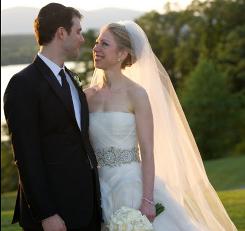
Chelsea Clinton, a Methodist, and Marc Mezvinsky, a Conservative Jew, had their very private wedding on Saturday. But the public may not be done peering through the shrubbery at their lives.
Like it or not, the famous bride and groom will continue to be the focus of scrutiny for their religiously mixed marriage — a category that's
growing rapidly among U.S. couples.
Two decades ago, 25% of U.S. couples didn't share the same faith. That was up to 31% by 2006-08, according to the General Social Survey by the National Opinion Research Center at the University of Chicago. The number was even higher, 37%, in the 2008 U.S. Religious Landscape Survey by the Pew Forum on Religion & Public Life. Both surveys included people who crossed major traditions, such as Jewish-Protestant, believers married to the unaffiliated, and Protestants of different denominations, such as former president Bill Clinton, a Baptist, and Secretary of State Hillary Rodham Clinton, a Methodist.
For those of nominal faith, this is no big deal. "Everybody party" is a popular way to avoid doctrinal conflicts, however thin on theology. But for those who hold deep but different faiths, life-cycle decisions will loom, from baptism (No? Yes? Whose church?) to burial (Can you rest in sacred ground of another faith?). Every rite of passage, sacred ritual and major holy day will require negotiation: First Communion? Bar or bat mitzvah? Passover Seder, Easter vigil or Eid Al-Fitr feast to break Islam's Ramadan fast?
Looking on: Parents and clergy who fear that distinctive beliefs, sacred rituals and centuries-old cultural traditions will be diluted or discarded.
Is True Friendship Dying Away?
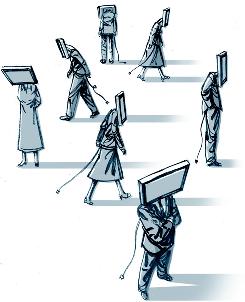
To anyone paying attention these days, it's clear that social media — whether Twitter, Facebook, LinkedIn or any of the countless other modern-day water coolers — are changing the way we live.
Indeed, we might feel as if we are suddenly awash in friends. Yet right before our eyes, we're also changing the way we conduct relationships. Face-to-face chatting is giving way to texting and messaging; people even prefer these electronic exchanges to, for instance, simply talking on a phone.Smaller circles of friends are being partially eclipsed by Facebook acquaintances routinely numbered in the hundreds. Amid these smaller trends, growing research suggests we could be entering a period of crisis for the entire concept of friendship. Where is all this leading modern-day society? Perhaps to a dark place, one where electronic stimuli slowly replace the joys of human contact.
Awareness of a possible problem took off just as the online world was emerging. Sociologist Robert Putnam published the book Bowling Alone, a survey of the depleting levels of "social capital" in communities, from churches to bowling allies. The pattern has been replicated elsewhere in the Western world. In the United Kingdom, the Mental Health Foundation just published The Lonely Society, which notes that about half of Brits believe they're living in, well, a lonelier society. One in three would like to live closer to their families, though social trends are forcing them to live farther apart.
Typically, the pressures of urban life are blamed: In London, another poll had two-fifths of respondents reporting that they face a prevailing drift away from their closest friends. Witness crowded bars and restaurants after work: We have plenty of acquaintances, though perhaps few individuals we can turn to and share deep intimacies. American sociologists have tracked related trends on a broader scale, well beyond the urban jungle. According to work published in the American Sociological Review, the average American has only two close friends, and a quarter don't have any.
No One Left to Pray To?

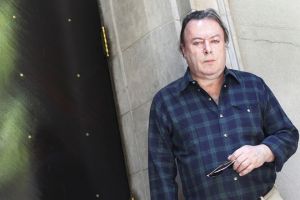
If God occasionally intervenes in the world to shoot down an atheist—to show who's boss, or simply to vent—it makes sense for Him to target the esophagus.
As organs go, it's long and conveniently placed, stretching from throat to stomach, making a good target for an elderly yet determined deity with possibly shaky hands. Its importance to speech heightens the symbolic force intended. And its connection to swallowing suggests the irony some believers think God enjoys too much: You can't swallow me? You won't swallow anything!
For atheist apostle and recent memoirista Christopher Hitchens, who announced on June 30 that he'd cancel the rest of his Hitch-22 book tour to undergo chemotherapy on said cancerous organ, the argument for such personalized intelligent design presumably doesn't hold. Hitch does recognize the role of vengeance and ressentiment in believer/nonbeliever relations, but only in fueling institutions established by believers further down the Great Chain of Being. "Religion," he wrote in God Is Not Great, "does not, and in the long run cannot, be content with its own marvelous claims and sublime assurances. It must seek to interfere with the lives of nonbelievers, or heretics, or adherents of other faiths."
One thing's for sure—Hitch is not in great health. Indeed, he faces the possibility of not being at all if the chemo proves useless. Should believers pray for him, a man celebratedly insensitive to norms of politeness and acts of altruism? He is, after all, the same character who, in The Missionary Position (1995) and elsewhere (a film, Hell's Angel, and numerous author appearances), deemed Mother Teresa "the ghoul of Calcutta." To Hitchens, the "world's best-known symbol of selfless charity" (as The Philadelphia Inquirer once described her) evinced "a penchant for the rich and famous, no matter how corrupt and brutal." Hitch is also the stern moralist who judged onetime Oxford acquaintance Bill Clinton, who's done a few good deeds in his time, as "indescribably loathsome," a phony with "no one left to lie to." Hitchens is the self-appointed judge and jury who found Nobel Peace Prize winner Jimmy Carter "a pious, born-again creep," and Jewish philosopher Martin Buber a "pious old hypocrite."
Within a week of Hitchens's announcement, 1,619 people offered comments on Huffington Post's report of his bad news. Another 335 kicked in on his own Vanity Fair blog. Hundreds of comments appeared on the personal site of one woman who set out a formal argument for why Christians should pray for Hitchens.
Obama's 10 Most Important Faith Leaders

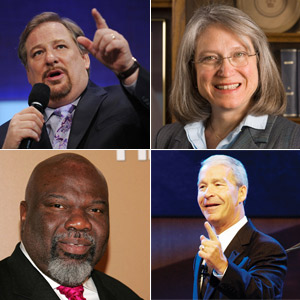
Even before Barack Obama was elected president, religious figures loomed large in his political career. The greatest threat to his presidential campaign came not from another candidate but from his longtime pastor, Jeremiah Wright, whose controversial sermons prompted questions about Obama's judgment in associating with him. After Election Day, the first big controversy of the Obama era was the president-elect's invitation to evangelical preacher Rick Warren, an opponent of abortion rights and gay marriage, to give the opening prayer at his inauguration. And Obama has offered religious leaders an unusually prominent role in his administration by convening an advisory council for the White House faith-based office that's dominated by clergy and heads of religious groups.
In an administration that keeps in touch with hundreds of faith leaders, here are the 10 most important.
THE REV. JOEL HUNTER: Pastor of Northland Church, Longwood, Fla.
The Rev. Joel Hunter's resignation as president-elect of the Christian Coalition in 2006 over disagreements about the organization's strictly hot-button agenda turned him into an emblem of a new generation of evangelicals, one that toes the conservative line on abortion but embraces progressive causes like environmentalism. A megachurch pastor based near Orlando, Hunter was among the evangelical leaders whom Obama courted on the campaign trail last year. Hunter delivered the benediction at the Democratic National Convention and has since emerged as a top faith-based surrogate for the president, defending him on matters as diverse as embryonic stem cell research and his selection of Kathleen Sebelius as health and human services secretary. The White House consulted him in drafting Obama's recent address to the Muslim world.
THE REV. JIM WALLIS: President and Executive Director of Sojourners
Progressive evangelical Jim Wallis has been a political oddity ever since he landed in Washington more than 35 years ago. Lobbying for poverty relief and against war, Wallis was at odds with Christian right leaders who claimed to speak for evangelical America. His politics lined up with the Democrats, but the party had little use for evangelical pastors. As younger evangelicals have branched out beyond hot-button issues and Democrats have begun wooing born-again Christians, however, Wallis is suddenly very much in demand.
Richard Dawkins's Backward Logic over Atheist Schooling
Richard Dawkins's belief that any properly brought up child will naturally be an atheist leads him into absurdity.
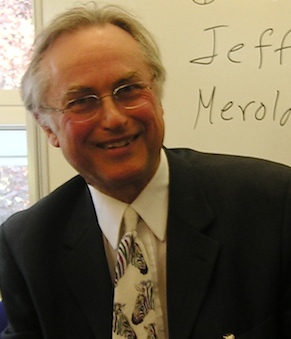
Richard Dawkins on Mumsnet came up with a remark to silence all his critics: "What have you read of mine that makes you think I have a skewed agenda?" It certainly left me opening and shutting my mouth like a breathless goldfish. Actually the whole thread is worth reading: it is from here that the story has come forth that he wants to start an atheist school. Whether that will actually happen is another thing. But it is in any case revealing of his reasoning. (There doesn't seem to be a way to link to individual comments on Mumsnet, but all these quotes are cut and pasted from the thread.)
He was asked by one commenter:
"What would you say to parents of children who attend quite orthodox state-funded schools who are very anxious that their child be educated within that context? I am thinking specifically of the ortho-Jewish schools around my way (north London). I know for a fact a lot of these parents cannot countenance the idea of their child being educated within a non-Jewish school. What do you think they should do?"
His response was:
"That's a good point. I believe this is putting parental rights above children's rights."
It is impossible to read this as meaning anything but that children have a right to be educated as Richard Dawkins thinks fit, but not as their parents do. He alluded several times in the threat to the sufferings of atheist parents forced to send their children to faith schools:
"Is it better to stand by one's principles or be hypocritical in order to provide the best option? What a horrible dilemma to be forced into."
But apparently this doesn't apply if your principles are religious ones, because then your children have a right to be educated as atheists.
Of course, the Dawkins position here is purely a matter of assertion. It's impossible to imagine anything that might qualify as evidence for the view that it is okay for atheists to discriminate against parents who have particular religious beliefs, while it is very wrong for believers to do so.
But "evidence", tends to be defined backwards in these polemics – in other words, he starts from the axiom that there is no evidence whatsoever for the existence of God, (implied here in his remark that "Every atheist I know would change their mind in a heartbeat if any evidence appeared in favour of religious belief") and then find meanings for the term that fit this use. This is of course the same trick as defining faith as belief without evidence and then using this definition as proof that faith is irrational.
An Agnostic Manifesto
At least we know what we don't know.
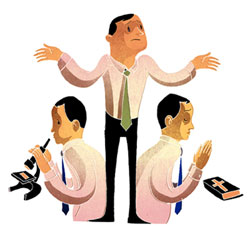
Faced with the fundamental question: "Why is there something rather than nothing?" atheists have faith that science will tell us eventually. Most seem never to consider that it may well be a philosophic, logical impossibility for something to create itself from nothing. But the question presents a fundamental mystery that has bedeviled (so to speak) philosophers and theologians from Aristotle to Aquinas. Recently scientists have tried to answer it with theories of "multiverses" and "vacuums filled with quantum potentialities," none of which strikes me as persuasive. (For a review of the centrality, and insolubility so far, of the something-from-nothing question, I recommend this podcast interview with Jim Holt, who is writing a book on the subject.)
Having recently spent two weeks in Cambridge (the one in the United Kingdom) on a Templeton-Cambridge Fellowship, being lectured to by believers and nonbelievers, I found myself feeling more than anything unconvinced by certainties on either side. And feeling the need for solidarity and identity with other doubters. Thus my call for a revivified agnosticism. Our T-shirt will read: I just don't know. (I should probably say here that I still consider myself Jewish in everything but the believing in God part, which, I'll admit, others may take exception to.) Let me make clear that I accept most of the New Atheist's criticism of religious bad behavior over the centuries, and of theology itself. I just don't accept turning science into a new religion until it can show it has all the answers, which it hasn't, and probably never will.Times Change at the Vatican
A forgotten encyclical on virginity shows just about everything that the Vatican can get wrong.

We've all made terrible mistakes with search and replace, but the Vatican's webmaster has come up with a classic: if you look up Pius XII's 1954 encyclical on Sacred Virginity, as who wouldn't, you will learn in paragraph 3 that:
"Right from Apostolic Times New Roman this virtue has been thriving and flourishing in the garden of the Church."
Presumably this was the result of a script which was meant to affect only style sheets, and change references to the "Times" font to the more precise "Times New Roman". I would have thought that under the present pontiff they would anyway have changed to some more suitable font, like "Times Unchanging Roman".
But in fact the church does change, and nothing could make this clearer than the encyclical itself. It shows us a world which is now gone forever – and good riddance.
St. Peter Damian, exhorting priests to perfect continence, asks: "If Our Redeemer so loved the flower of unimpaired modesty that not only was He born from a virginal womb, but was also cared for by a virgin nurse even when He was still an infant crying in the cradle, by whom, I ask, does He wish His body to be handled now that He reigns, limitless, in heaven?"
Has Kylie got Kabbalah?
Kylie's wearing the red bracelet. But is Kabbalah an easy option for celebrities who don't want religion to change them too much?

Is Kylie now one of that select group, identifiable by their first names alone – Madonna, Paris, Britney – who might be seen sneaking in and out of the Kabbalah Center in Beverly Hills? She's been photographed wearing the red string around her left wrist, to ward off the evil eye. Her new beau, Andres Velencoso, is said to be interested in the mystical offshoot of Judaism. Should we mock? Or should we don a phylactery with her, even as we don our hot pants? Should we even ask whether there's something in it?
What is Kabbalah anyway? It emerged during the 13th century, in Spain, when Jewish philosophers sought a rational understanding of their religion. By this, they meant deploying the science of the day to interpret texts – gematria, which assigns numerical values to letters, and the like. The result was a kind of mystery religion that stressed the unknowability of the Godhead, whom they called En Sof, or "Without End".
That combination of pseudo-science and mysticism must be part of the modern Kabbalah appeal. Its devotions are often material and embodied – to do with food, from the rituals of a Shabbat meal to drinking Kabbalah water – and that must resonate with the imperatives of celebrity life, which is nothing if not anxious about the body.
And attached to that discipline comes the mysticism – rudely referred to as "McMysticism" or "spirituality for dummies". The En Sof of the first Kabbalists has become the "higher power" of the modern ego. Celebrity narcissism? In some ways, we're talking here about folk who have conquered the world. The "Without End" must be relatively easy to believe in, when fans will fill stadiums to see you, and your smile instantly warms the hearts of millions.
A New Solution to the Problem of Evil?
A psychological paper which claims to explain the religious account of evil is troublingly simplistic.
That there is suffering in the world, few would doubt. But whether or not that suffering unsettles belief in God divides individuals roughly into two. For one group, call them rationalists, the fact of suffering is perhaps the best reason for not believing in God. But for the other, call them religionists, the fact of suffering is the very reason to invoke the divine – God being a source of consolation, or a way of talking about the mystery of suffering, the otherwise imponderable "why?"
A new paper, published in Personality and Social Psychology Review, has an explanation for why the religionists hold their view, the one that is so bewildering to the rationalists. Kurt Gray and Daniel Wegner, Harvard psychologists, argue that we tend to see moral players as either agents or patients. Agents do good or evil. Patients receive good or evil. Further, we also tend to assume that once an agent always an agent, and once a patient always a patient: individuals are "typecast" into being either heroes and villains, or recipients and victims.
This leads to the following conclusion. "When people experience unjust suffering or undeserved salvation, they search for someone to blame or praise, but when no person can be held responsible, they look to the supernatural for an agent, finding God." Link that to moral typecasting, and you get the notion that God is responsible for good, and Satan for what's bad.
I have to say that I find the paper wildly simplistic and entirely unconvincing. And troubling too.
Why so? Well, for one thing, I can't make the internal logic of the paper itself stack up. It begins by asking why people believe in God when there's suffering, the implied problem being how a good God can cause bad suffering. But then, a few paragraphs on, it's not God who is proposed as the agency behind the bad in our lives, but Satan. And yet, if God is not responsible for suffering, then there's no problem of evil. You can blame it all on Satan. (It's a Manichaeist view of the world, one rejected by orthodox theism, which is why the problem of evil doesn't admit such easy resolution. But that's not the concern here.)
The Vatican Reaches Out to Unbelievers
The Catholic church wants dialogue with agnostics and atheists. So what could we learn from them, and they from us?
It seems that the Vatican is about to create a "Pontifical Council for New Evangelisation". Its goal would be to reach out to agnostics and atheists. (Best guess from one Vatican watcher suggests an announcement on the 29th of this month). The Pontifical Council for Culture has been thinking along such lines since at least 2004, asking how the church should respond to contemporary unbelief and religious indifference.
Archbishop Gianfranco Ravasi, who heads up the culture council, has explained that any effort would not be aimed at "polemical" atheists because they "read religious texts like fundamentalists", and so are not open to dialogue. No love lost there, then. But might this initiate make for a real exchange between those on the inside and outside of faith, who value the Christian tradition?
If so, the Vatican will have to acknowledge that it can positively gain from the insights of agnostics and atheists – much, perhaps, as the priests need the prophets in the Hebrew Bible. Without such gadflies, the church becomes sluggish simply on account of its size – to recall the remark that Socrates made about ancient Athens. In other words, the Court of the Gentiles, as the new council is also known, will have to be less about evangelisation, and more about dialogue.
There are occasionally moments when the Vatican sounds open. "Who are the non-believers? What is their culture? What are they saying to us? What can we say to them? What dialogue can we establish with them?" the Pontifical Council for Culture has asked. Well, here are three suggestions for dialogue where those of us on the outside of faith might have something of value for those on the inside.
Senegal Street Children and Religious Schooling

In most any city in the world, you’ll find beggars — the homeless, the disabled, those down on their luck. In the West African city of Dakar, the capital of Senegal, many beggars are children. How those children end up on the streets is a complex tale that often involves Senegal’s religious schooling system. It’s a system that many now want to reform. Jori Lewis has the story from Dakar.
****
MARCO WERMAN: In most any city in the world, you’ll find beggars, the homeless, the disabled, those down on their luck. In the West African city of Dakar, the capital of Senegal, many beggars are children. How those children end up on the streets is a complex tale that often involves Senegal’s religious schooling system. It’s a system that many now want to reform. Jori Lewis has the story from Dakar.
JORI LEWIS: There is a word for runaway children here. In the local language Wolof, they’re called Fakhman. I visit a known Fakhman hang out near the bus station and the prison. People mill about in the evening getting food from tiny stands. A group of men sings religious songs to pass the time. A boy comes up to me. His friends follow. Here is the Fakhman house, he says, gesturing to the crowded street. One 13-year-old boy named Baye Zaal Faye tells me he’s been on the street for a year.
INTERPRETER: I beg and sometimes I gather scrap metal.
LEWIS: He says life on the street is difficult. It’s hard to make money and even when he does, it’s not so easy to keep.
INTERPRETER: Sometimes when you go to sleep there are people who come and take your money right out of your pocket.
LEWIS: Child beggars are everywhere you look here. In the shadow of the Senghor Stadium, by a camp fire at the Soumbedioune fish market, on the sidewalks of downtown Dakar’s major thoroughfares where boys unroll cardboard boxes for bedding and sleep with pink rice sacks for blankets. And among the children you see on the street, there is an astonishing diversity. There are children sent by their poor parents to make money. Children with no families at all to return to. But for many of these kids, the path to the streets begins in school, traditional Koranic schools called daaras. At this daara in the northern Senegalese city of Saint Louis, children recite their lessons from wooden tablets. Moussa Sow is the lead teacher of the daara. He says boys from all over Senegal come live at the school for several years, learning Arabic and the Koran.
INTERPRETER: Each child who completes a daara education, that will make him a great man.
LEWIS: He says a daara education makes men who are good citizens. That’s why some parents choose this religious education over secular state schools. It’s a kind of gift a father gives to his son. Some of the parents send money to support the school too, but not many. The school largely serves the poor, so it doesn’t ask for a fee. Moussa Sow says it’s hard to provide for all of the students’ needs.
listen now or download mp3 audio, 9 minutes
Coping in Extremism
In a world of total uncertainty, can religion's accumulated wisdom offer solace?
Uncertainty was a theme, I think, over the bank holiday at Hay-on-Wye, during the literary festival. Perhaps that's not surprising. Much of what we thought we knew has recently been thrown into doubt, be that in politics or economics. But it was striking how religious language seemed never far from the mouths of those authors with an interest in the theme.
You'd expect as much from Karen Armstrong, the historian of religion. Her complaint is that those who talk about God today, be they religious or not, tend to do so as if they knew what they were talking about. It's not a mistake made by the great God-botherers of the past.
Take Thomas Aquinas, and his so-called five "proofs" for the existence of God. They're better referred to as five "ways", the word Thomas used being "viae". What Thomas is not saying, then, is that his five ways just about wrap up the case for God. Rather, he is simply beginning with "what everyone understands by God", as he himself puts it. (By everyone, he meant the cutting-edge authorities of his time, notably Aristotelian science and Islamic philosophy.) The ways just set the ball rolling, as the philosopher of religion Brian Davies explains.
It's a discussion to which Thomas quickly adds that God's existence does not come to us "in any clear and specific way", because we basically have no idea what we mean when we use the word "God". Instead, we have to work with what we do know, about the world in which we live, and about the experience of our lives. We must be content with what that reveals.
David Eagleman, author of the surprise bestseller Sum, said a not dissimilar thing. As a neuroscientist, he describes his work as like being led to the end of a pier, only to realise that there are vast seas of unknowing stretching out before you. Much the same could be said of science in general.
His book is a series of often witty sketches about possible scenarios for the afterlife, and he wrote it in order to keep his mind open to what's uncertain. He subsequently coined the word "possibilism", and it's caught on. I think it's fair to say that the word represents the infinity that lies beyond our grasp. Eagleman is no believer. But that's a definition of God with which Thomas might have been happy; a starting point to set the ball rolling.
An Alternative Model for Protestant Politics
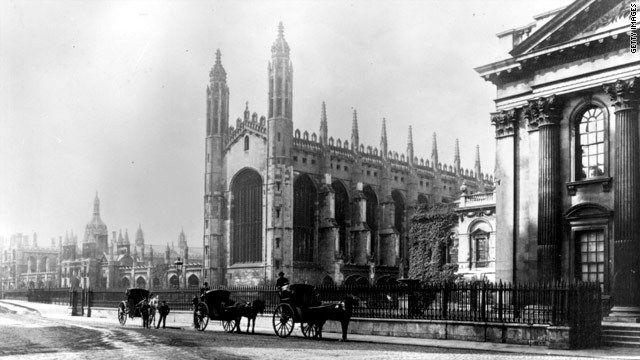
An American preacher rails against the popular caricature of believers as backwards and narrow-minded, decries the popular culture’s hostility toward religion and implores Christians to stop being so politically correct in the workplace and to start loudly expressing their faith-based opinions. Sounds like a typical evangelical Protestant minister, cribbing lines from Focus on the Family.
Another American preacher decries imminent government cuts to programs for the poor, urging Christian churches to mobilize politically to protect society’s most vulnerable. Sounds like a typical mainline Protestant minister, cribbing lines from Jim Wallis.
Christian conservatives feel besieged by the secular culture, liberal Christians want more social justice. Everyone knows that.
So it came as a surprise to hear both sentiments expressed Sunday morning in the same Protestant sermon – not by an American minister but by a Brit, preaching in one of England’s most illustrious Anglican churches. The church was Cambridge University's King’s College Chapel, completed by Henry VIII in the early 1500s and, to this day, boasting the world’s largest fan-vaulted ceiling. I stopped into the church, pictured above circa 1880, because I’m in town on a fellowship.
Unknown Unknowns
In his first Reith lecture, Martin Rees discussed the "scientific citizen". How we proceed in areas such as genetics, brain science and artificial intelligence ought to involve the views of the public, he said. And that means they need to be able to make informed choices.
Rees argued that this includes giving people a sense of how confident we can be in science's claims; the public needs to know about what Donald Rumsfeld would term the "known unknowns". But Rees didn't talk about the unknown unknowns.
At this year's meeting of the American Association for the Advancement of Science, a panel of statisticians demonstrated that many scientific findings are much weaker than even scientists realise. Reruns of published health studies, for example, get the same finding as the original only 5 per cent of the time.
Then there are the results that are clearly wrong. "Statistically significant" studies have shown, for instance, that breathing in pollution reduces heart problems, and that living in a polluted city is as harmful as smoking 40 cigarettes a day. Somehow these results were peer-reviewed and published, yet common sense tells us they are implausible.
Yet often the studies are too complex for common sense to penetrate the data - and here is where things go awry. Usually, scientists use statistics to decide whether there is less than a 5 per cent chance that their apparently significant result could be the result of random effects. But the small print says this depends on their doing a simple, single test that is decided upon in advance. If you test many things at once, or make decisions on analysis after looking at the data, the probability of a mistaken conclusion goes through the roof.
A study published in 2008 in the Journal of the American Medical Association showcases a typical pratfall. The study analysed the results of exposure to 275 chemicals, looking at 32 possible resulting health problems. It found that exposure to BPA, a chemical used in the manufacture of plastics, could result in diabetes and liver and heart problems. But the result is meaningless. In total, the study involved nearly 9,000 different tests and offered nine million different ways to analyse the data. Any of its findings could reasonably be the result of chance.
A Supreme Court without Protestants?

CNN) -- For most of American history, a Supreme Court with no Protestant Christian judges would have been unthinkable. Nearly three-quarters of all justices who've ever served on the nation's high court have been Protestant. And roughly half of all Americans today identify themselves as Protestant.
But since Justice John Paul Stevens announced his retirement last month, legal and religious scholars have begun entertaining the unprecedented prospect of a Supreme Court without a single Protestant justice.
Besides Stevens, who is Protestant, the current Supreme Court counts six Catholics and two Jews.
"It's an amazing irony, given how central Protestantism has been to American culture," said Stephen Prothero, a religion scholar at Boston University. "For most of the 19th century, Protestants were trying to turn America into their own heaven on Earth, which included keeping Jews and Catholics from virtually all positions of power."
Many religion scholars attribute the decline of Protestant representation on the high court to the breakdown of a mainline Protestant identity and to the absence of a strong tradition of lawyering among evangelical Protestants.
"Mainline Protestantism isn't a pressure group," said Prothero, "It's not like the National Council of Churches is lobbying Obama to get a Lutheran appointed to the Supreme Court."
And while Judaism and Catholicism have their own sets of religious laws that date back millennia, many branches of Protestant Christianity do not. For much of the last 150 years, evangelical Christianity has stressed an emotional theology of heart over head -- not a recipe for producing legal scholars with eyes fixed on the Supreme Court.
Myth, Heaven, and Galileo
What we can see in the stars depends on our instruments and on our expectations. The instruments are easier to improve.
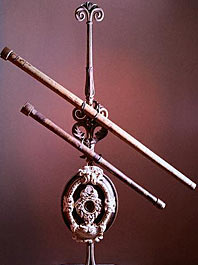
Some months back, I wrote a piece about Galileo's science, and how the discoveries of his telescope ought to have led him to conclude that Copernicus was wrong. This morning I had a letter – an actual posted, folded, paper letter – from Kentucky. It came from Christopher Graney, the science teacher whose work lay behind the Nature article, and contained a copy of his original paper setting out the full reasoning in terms that even high school students and national newspaper journalists can understand.
Given the resolution of early telescopes, and the assumption of all early astronomers that what they saw through them were the stars themselves, and not the apparently much larger "Airy disks" produced by diffraction, Galileo's telescope showed that the earth must rotate (so the mediaeval picture was wrong), but could not have gone round the sun, as Copernicus believed.
What Galileo should have believed, according to this reconstruction, was the system put forward by Tycho Brahe, which had the earth at the centre, and the moon and sun orbiting us, while all the other planets orbit the sun. This piece was based on a short note in Nature and provoked a fairly lively debate about science and judgement here.
It's still complicated, of course. There is a reason why Galileo and Kepler are remembered as geniuses. But two facts are important. The first is that there is no way to decide from the measurements of planetary orbits available in the seventeenth century whether Tycho was right and all the planets orbit the sun except the earth, around which the sun revolves, or whether Copernicus was right and all the planets, including the earth, revolve around the sun. An evidence dalek would have been stuck on the staircase here, because the evidence of planetary observations gave no ground to choose between the two theories. What mattered in making the decision were the observations of the stars.
Values Added: National Day of Diavlog
This discussion between Amy Sullivan (Time Magazine) and David Gibson (Politics Daily) covers:
Is Obama co-opting, neutralizing the National Day of Prayer? (13:46)
Ramifications of the "Mojave cross" case ruling (03:35)
Does a Supreme Court justice’s religion still matter? (10:53)
The Court and the rise of the Religious Right (01:08)
What did Pope Benedict know, and when did he know it? (12:05)
Churches attack AZ immigration law, call for national reform (09:39)
Survey: 72% of Millennials 'More Spiritual than Religious'
"We have dumbed down what it means to be part of the church so much that it means almost nothing, even to people who already say they are part of the church," Rainer says.
The findings, which document a steady drift away from church life, dovetail with a LifeWay survey of teenagers in 2007 who drop out of church and a study in February by the Pew Forum on Religion & Public Life, which compared the beliefs of Millennials with those of earlier generations of young people.
The new survey has a margin of error of +/-2.8 percentage points.
Even among those in the survey who "believe they will go to heaven because they have accepted Jesus Christ as savior":
· 68% did not mention faith, religion or spirituality when asked what was "really important in life."
· 50% do not attend church at least weekly.
· 36% rarely or never read the Bible.
Neither are these young Christians evangelical in the original meaning of the term — eager to share the Gospel. Just 40% say this is their responsibility.
Denialism: Media in the Age of Disinformation

A few hundred years after the Enlightenment, western civilization is rushing back to the Dark Ages. The causes are debatable, but, argue these science journalists, the public increasingly rejects the findings of science, from climate change to evolution, and is turning away from rationality and reason in general.
"People are afraid of anything that will hammer away at their preconceived notions," says Michael Specter. He points to the fanatic opposition in some quarters to genetically engineered foods, and the worship of organic products. Almost everything we eat is the result of genetic modification, he notes, and "organics kill people, too." It doesn’t make sense to think that returning to "the old ways" will keep us healthy and supply the world with food. "We’re hurting ourselves in lots of ways," says Specter, when people insist on believing what they want.
Human nature plays a big part in feeding denialism, believes Chris Mooney. "We all ... argue against information that contradicts our existing worldview." The unfortunate evolution of media in the digital age is feeding our inherent "confirmation bias," and today "Americans with different political leanings construct different realities." We must "give up" on the idea that truth triumphs and society advances as more people become critical thinkers. Concludes Mooney, "We have to work with the media and brains we have, and seek realistic change."
Vatican Responds to Hans Kung's Critique of Pope
VATICAN CITY (RNS) The Vatican's official newspaper published a prominent yet understated rebuke of the Rev. Hans Kung, the dissident Catholic theologian, for his latest criticisms of Pope Benedict XVI.
Appearing on the front page of the Friday (April 23) edition of L'Osservatore Romano, the article responded to an April 16 open letter that Kung wrote to the world's Catholic bishops.
In that letter, the Swiss theologian accused Benedict of betraying the modernizing reforms of the Second Vatican Council (1962-65) and of engineering, when still known as Cardinal Joseph Ratzinger, a "worldwide system of covering up cases of sexual crimes committed by clerics."
Responding in L'Osservatore Romano, Pier Giordano Cabra (identified as Kung's first publisher in Italy) addressed the theologian in the form of a letter, under the headline "Dear Hans."
Cabra told Kung that "perhaps if your letter had breathed a bit more of the hymn to charity, it would have turned out to be a more elegantly evangelical gesture of congratulations" for Benedict's 83rd birthday and fifth anniversary as pope, as well as "a more fruitful contribution to the church that is suffering for the weakness of her sons."
Kung and Ratzinger were colleagues on the theology faculty of the University of Tubingen, Germany, in the mid-1960s. The two have long been opponents in theological debates. Pope John Paul II deprived Kung of his license to teach as a Catholic theologian in 1979.
On Top of Microwave Mountain
I tried to sauté my brain at the base of a cell phone tower. It didn't work.
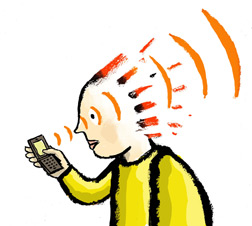
Not many people drive all the way to the top of Sandia Crest, 10,678 feet, to hang out by the Steel Forest—the thick stand of blinking broadcast and microwave antennas that serves as a communications hub for New Mexico and the Southwest. But I went there on a dare. For the past few months, I've been trying to understand the thinking of some anti-wireless activists who have turned my town, Santa Fe, N.M., into a hotbed for people who believe that microwaves from cell phones and Wi-Fi are causing everything from insomnia, nausea, and absent-mindedness to brain cancer.
"Spend an hour or two in front of the antennas," I was advised by Bill Bruno, a Los Alamos National Laboratory physicist and self-diagnosed "electrosensitive" who sometimes attends public hearings wearing a chain-mail-like head dress to protect his brain. "See if aspirin cures the headache you'll probably get, and see if you can sleep that night without medication."
So while carloads of visitors took in the high mountain air and breathtaking views of the Rio Grande Valley, I wandered around with a handheld microwave meter to make sure that I spent no less than two hours basking in high-frequency electromagnetism at an intensity of up to 1 milliwatt per square centimeter. (That is the threshold set by the FCC for safe exposure over a 30-minute interval.) The device also measured the magnetic fields buffeting the mountain, which spiked at 100 milligauss, about one-five-hundredth as strong as a refrigerator magnet.
My head felt fine as I drove back to Santa Fe, and I slept soundly that night, reinforcing my doubts that the growing presence of wireless communication devices can be blamed for anything worse than sporadic outbreaks of hysteria, which has been defined in the psychiatric literature as "behavior that produces the appearance of disease."
As Controversy Lingers, Shroud of Turin Still Draws a Crowd

TURIN, Italy (RNS) As hoteliers and souvenir vendors from Lourdes to Mexico City can readily attest, a sacred pilgrimage can quickly morph from a spiritual event into a commercial bonanza.
And although religious tourism has recently become a booming global industry, it's still rare for religious leaders themselves to sanction a pilgrimage for explicitly economic motives.
But the Shroud of Turin has always known how to draw a crowd.
The shroud, long venerated as the actual burial cloth of Jesus, was last displayed to the public in 2000. Its next exhibition wasn't expected until 2025, in part to protect the shroud's mysterious image -- the front and back of a 5-foot-11-inch man -- from the fading effects of light.
But when civic leaders in this automotive powerhouse sought to boost their crisis-stricken economy with an influx of tourism, the Catholic Church was ready to help.
Turin's Cardinal Severino Poletto, who maintains the relic on behalf of the pope in the Turin cathedral, agreed to a special six-week display this spring, which began April 10 and runs through May 23. Officials also hope to showcase other local attractions, including restored historic palaces and a cuisine gastronomes consider Italy's most refined.
This unusual bit of economic stimulus already seems to be working.
Over 1.5 million of the 2 million available free tickets to see the relic have been snatched up, and the city government says even the priciest hotels are booked solid for all weekends during the period.
Pope Benedict XVI himself will come to venerate the shroud on Sunday (May 2).
Studying Voodoo Isn't a Judgment
Journalists should deal with religion respectfully, of course. But that doesn’t mean dismissing the tough questions.
Did you hear about the Protestant minister who said that Haiti "has been in bondage to the devil for four generations"? No, it wasn't Pat Robertson but Chavannes Jeune, a popular Evangelical pastor in Haiti who has long crusaded to cleanse his nation of what he believes is an ancestral voodoo curse. It turns out that more than a few Haitians agree with Jeune and Robertson that their nation's crushing problems are caused by, yes, voodoo.
I know this not because I read it in a newspaper or saw it on TV, but because of a blog. University of Tennessee-Knoxville cultural anthropologist Bertin M. Louis Jr., an expert on Haitian Protestantism, posted an essay exploring this viewpoint on The Immanent Frame, a social scientist group blog devoted to religion, secularism and the public sphere.
Elsewhere on The Immanent Frame, there's a fascinating piece by Wesleyan University religion professor Elizabeth McAlister touching on how the voodoo worldview affects Haiti's cultural and political economy. She writes that the widespread belief that events happen because of secret pacts with gods and spirits perpetuates "the idea that real, causal power operates in a hidden realm, and that invisible powers explain material conditions and events." Though McAlister is largely sympathetic to voodoo practitioners, she acknowledges that any effective attempt to relieve and rebuild Haiti will contend with that social reality.
In a recent New York Times column, religion reporter Samuel G. Freedman rightly lamented the way the American news media have largely ignored voodoo in their Haiti earthquake reporting. But he also chided media commentators (including me) for speculating about voodoo as a harmful cultural force. Freedman quoted academics who praised the Haitian folk religion, and who complained about the ignorance and supposed racism of voodoo skeptics.
Discovery: All Persuasive Life is Here
Psychologist Kevin Dutton explores how to transform a situation with extreme persuasion.


At the end of a dinner party, Winston Churchill spots a fellow guest surreptitiously pocketing an expensive silver salt-cellar. To avoid an undignified contretemps, Churchill has to think quickly. He picks up a silver pepperpot and places it in his own coat pocket. Then, approaching the gentleman in question, takes the pepperpot out of his pocket and sets it down in front of him. "I think they’ve seen us," he says. "We had better put them back." Dumbfounded, the would-be thief returns the stolen salt-cellar to its rightful place.
That’s a small example of the creative, split-second negotiating skill that characterises extreme persuasion. On the larger stage of international conflict, industrial relations, business deals and even fraud, it’s a technique that can transform the world. Some show great talent for it. These are the extreme persuaders.
In this programme, we look at the evolutionary and psychological roots of extreme persuasion. Game theory shows the selective advantage of cooperation through negotiation; brain science reveals how we are wired to take mental short-cuts, discarding the irrelevant to get maximum advantage from minimum effort. Some learn the skills, in others they seem innate. We meet professional persuaders and gifted amateurs to learn their secrets.
- listen… [bbc iplayer]
How to Listen to God
An anthropological study of charismatic Christians reveals a belief system at once childish and sophisticated.
I went last night to a marvellous talk by an American anthropologist who has been studying Californian charismatic Christians. Tanya Luhrmann's enquiry into how these people construct their idea of God will result in a book eventually, but in the meantime her talk on her work with the Vineyard churches was full of insight, sympathy, and deadpan humour.
The Vineyard churches are a loose international network of mostly white, mostly middle class, very charismatic churches. They aren't exactly fundamentalist but they see the Holy Spirit everywhere and talk to God every day. They were the source of the "Toronto Blessing" - a craze which swept through the English charismatic network in the 90s where people fell on the floor and made animal noises. Luhrmann is interested in how you get to talk to God like this. After all, most churches for most of history, haven't done anything like that.
Her answer is that you need a certain kind of temperament, one which makes you good at make-believe, and then you need to work at it. The personality traits which make it easiest to talk to God are those measured on the Tellegen absorption scale, which she summarises as the ability to focus attention on a non-instrumental subject: in other words, some thought interesting for its own sake, whether or not it is obviously useful. It's the facility you need to construct compelling daydreams.
If you have this talent, or temperament, in the first place, these churches will nourish it. By treating God as real, you come to detect his presence more easily; and the God for whom the are searching is one just like another person. "People learn about God by mapping onto Him what they know about persons; then they map back what they suppose about God onto the world around them."
All this activity is the subject of tremendous social reinforcement. These are not Sunday only churches. Members can fill their lives with meetings with other members – and with God. "They pay constant attention to what's going on in their minds. They are constantly looking at their thoughts and images. It's a social shaping of what you would imagine to be a private space in their minds.
Pluralism Isn't a Modern Invention

We live in a plural world. It's a place in which every day you rub up against people with very different worldviews than your own. Your neighbor might be an atheist, a theist, a polytheist, an agnostic. Every variation on these metaphysical themes is being played out in a human life near you.
It's a new world, we think. Moreover, no one appears to be weakening in their convictions. If anything, divisive beliefs grow stronger. The Internet and Web sites; best-selling books; TV and radio programs tackling the 'big questions'. They tend to entrench views, not mediate differences. After all, conflict secures sales, not debate. A different opinion is not something to be shared, it's something to be defeated.
Which highlights something else about our plural age: it is quite possible to imagine changing worldview yourself.
We imagine that before modern times, a Christian, say, might have met an atheist, but they could no more have thought of becoming one than changing their sex. You can, in fact, now do both. Or, today you might be an agnostic, though you remember what it was once like to believe. You've changed once, so you might change again, and in a world of change, odds are that you will. So how can you be sure of what you now hold dear?
Or perhaps it's like investing in a stock market of meaning. It's hard to predict which belief stocks will rise or fall. Religious shares are volatile but high yielding. Perhaps agnostic bonds are a safer bet. And yet, who doesn't fear a faith crunch.
It all creates a deep sense of uncertainty and insecurity. The distinguished Canadian philosopher, Charles Taylor, has called them 'cross-pressures'. And it raises a big question: how are we to live together with these cross-pressure - different and yet still needing to share some sense of the common good.
There is no easy answer, but some clues might come from looking to the past. It's easy to think that pluralism is a quintessentially modern experience, and yet it was something that the ancient Roman world knew too. It was a plural place as well, the Mediterranean sea being the information superhighway of the times. In particular, Christians would sit at the feet of pagans, and vice versa, each learning from one another.
Focus on Your Family
The pro-life case for pregnancy termination
Focus on the Family certainly knows how to stir up an abortion debate. For two weeks, the country was buzzing about the group's Super Bowl ad. The ad, which featured college football star Tim Tebow and his mother, was expected to be preachy and controversial. Then Sunday arrived, and the commercial aired. What a letdown! Tim hugged his mom, they smiled, they said sweet things about love and family. Not a word about abortion. Liberals shrugged and moved on.
But wait a minute. Let's throw a challenge flag and review the video. The 30-second spot that ran on TV was just a teaser. It drew people to the Focus on the Family Web site. There, Focus has posted a much longer follow-up video in which its president, Jim Daly, interviews Tim's parents, Pam and Bob Tebow. That's where you'll find the abortion preaching we were expecting in the TV ad.
In the interview, Pam confirms and clarifies details of Tim's birth. Her pregnancy was every bit as dangerous as I inferred last week. She was 37 and working as a missionary in a remote part of the Philippines. "I was considered high-risk," she says. To make matters worse, "We lived in an area that didn't have great medical care." She recalls taking a pill and then realizing that its label said it could "cause severe birth defects."
In a previous account, Pam said she had been diagnosed with placental abruption, a premature—and often dangerous or lethal—detachment of the placenta from the uterine wall. In the Focus interview, Bob confirms that the abruption was serious. When Tim was born, "There was a great big clump of blood that came out where the placenta wasn't properly attached basically for the whole nine months," he says. "He was a miracle baby."
Church Statistics: Not Many Dead
The annual church attendance statistics tell a story of very gradual change--which is clearer in pictures than in words.
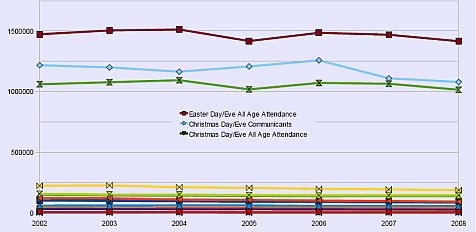
When I was first working at the Independent we were very proud of our photographs. One day there was a tragic little item on the PA wire about a young man who had hanged himself because he had been turned down for a job because of his terrible acne. The news editor looked at it. "This is a story crying out for a picture" he said.
That kind of demonstrative hard-boiledness is one journalistic vice. But the annual display of Church of England attendance figures brings out another one: the need to make sure that everything is exciting. I am reasonably certain that all the papers who notice it tomorrow will carry stories saying that the decline in church attendance continues. This is true, but it is another story crying out for a picture. And what the picture shows is not a graph that you could ski down, but one which would make for one of the duller stretches of a long cross-country trudge.
Nothing dramatic is happening. The Church of England says it's a little less of a decline; its various enemies say it's huge; journalists say that whatever it is, it must be dramatic. (note how the axis in this graph is chosen to maximise the drama) But, actually, what this suggests is that the action is happening elsewhere. There are graphs that would like much hillier: the collapse in Roman Catholic vocations was one; the rise in pentecostal subcultures here is probably another.
Voodoo Brings Solace to Grieving Haitians
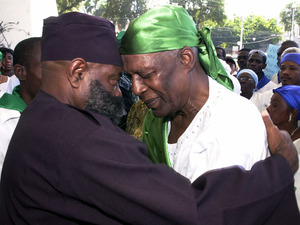
Erol Josue lost more than two dozen friends and extended family in Haiti's devastating earthquake. The Voodoo priest, who lives in New York, says he has spent the past week saying traditional Voodoo prayers.
"We thank God that we are still alive," he says, "but we also pray to give a good route, to give a good path for the people who passed away. And also we pray to ask the question, 'What happened?' "
Spirit Worship And Revelations
Voodoo is playing a central role in helping Haitians cope with their unthinkable tragedy. Outside of Haitian culture, few know what Voodoo is. Elizabeth McAlister, a Voodoo expert at Wesleyan University, says at its core, the philosophy is really pretty simple.
"Voodoo in a nutshell is about the idea that everything material has a spiritual dimension that is more real" than physical reality, she says. "So everything living — but even rocks and the Earth — is considered to have spirit and have a spiritual nature."
McAlister says there is no unified Voodoo religion. There's no "Voodoo Pope" or central authority, no Voodoo scripture or even a core doctrine. "It's a religion that really operates through revelation," she says. "So people can receive dreams or visions, and even be possessed by spirits, and that spirit can tell them something, and that's the revelation."
Widespread Below The Surface
And yet, Haitian Voodoo blends many of its rituals and beliefs — which came with the slaves from Africa — with Western Catholicism. For example, Voodoo believers worship Le Grand Maitre, or Grand Master, who is the equivalent of the Christian God.
They pray to loa, or spirits, who then intercede with God on their behalf — just as Catholics pray to saints. Voodoo believers also revere their ancestors, who guide them through their daily difficulties.
On the books, 80 percent of Haitians say they are Catholic. But Josue says Voodoo is widespread — just under the surface. "Haiti is not a Catholic country," he says. "Haiti is a Voodoo country."
Apparently that's what Pat Robertson thinks as well. Less than a day after the earthquake, the televangelist declared that Haiti has been cursed since 1791 when, he said, Voodoo practitioners "made a pact [with] the devil" to rid themselves of French occupiers.
listen now or download All Things Considered
- listen… []
The Hidden Brain and the Telescope Effect
How we think about tragedy

We know genocide is a greater tragedy than a lost dog. Or do we?
Washington Post staff writer Shankar Vedantam discusses the "telescope effect" and the manner in which our brains process tragedy and empathy in a Washington Post Magazine article adapted from his book, "The Hidden Brain: How Our Unconscious Minds Elect Presidents, Control Markets, Wage Wars and Save Our Lives," to be published this week. He took questions and comments January 19.
The transcript is below
____________________
Shankar Vedantam: Welcome to this online discussion about my Sunday magazine story -- Beyond Comprehension -- that was published last weekend. The story is excerpted from my new book, The Hidden Brain: How Our Unconscious Minds Elect Presidents, Control Markets, Wage Wars and Save Our Lives. The book is launched today by Random House Inc.
The excerpt is drawn from the final chapter of the book, which explores twin biases in the way we think about large numbers and small numbers. I argue in the excerpt published in the magazine that errors in the way our minds process large numbers leads us to make systematic errors in moral judgment. I cite a number of experimental studies, many of which were conducted by the superb psychologist Paul Slovic, that demonstrate how unconscious biases subtly alter our perceptions about different tragedies, and cause us to feel more visceral compassion when the number of victims is small, and less visceral compassion when the number of victims is large.
You can learn more about my book at www.hiddenbrain.org, follow the connections I make between unconscious bias and news events at www.twitter.com/hiddenbrain and form your own discussion group at www.facebook.com/hiddenbrain
_______________________
Freising, Germany: When you write that humans respond best to a single victim, I wonder if that has to do with empathy and perhaps also the instinct that if you help an individual, you yourself as an individual may someday be helped as well.
Shades of Prejudice

LAST week, the Senate majority leader, Harry Reid, found himself in trouble for once suggesting that Barack Obama had a political edge over other African-American candidates because he was "light-skinned" and had "no Negro dialect, unless he wanted to have one." Mr. Reid was not expressing sadness but a gleeful opportunism that Americans were still judging one another by the color of their skin, rather than — as the Rev. Dr. Martin Luther King Jr., whose legacy we commemorated on Monday, dreamed — by the content of their character.
The Senate leader’s choice of words was flawed, but positing that black candidates who look "less black" have a leg up is hardly more controversial than saying wealthy people have an advantage in elections. Dozens of research studies have shown that skin tone and other racial features play powerful roles in who gets ahead and who does not. These factors regularly determine who gets hired, who gets convicted and who gets elected.
Consider: Lighter-skinned Latinos in the United States make $5,000 more on average than darker-skinned Latinos. The education test-score gap between light-skinned and dark-skinned African-Americans is nearly as large as the gap between whites and blacks.
The Harvard neuroscientist Allen Counter has found that in Arizona, California and Texas, hundreds of Mexican-American women have suffered mercury poisoning as a result of the use of skin-whitening creams. In India, where I was born, a best-selling line of women’s cosmetics called Fair and Lovely has recently been supplemented by a product aimed at men called Fair and Handsome.
This isn’t racism, per se: it’s colorism, an unconscious prejudice that isn’t focused on a single group like blacks so much as on blackness itself. Our brains, shaped by culture and history, create intricate caste hierarchies that privilege those who are physically and culturally whiter and punish those who are darker.
Genesis, the Soap Opera
John Coats reclaims the first book of the Bible for the nonreligious.

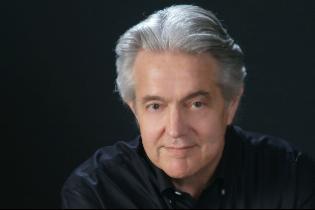
The book of Genesis forms a cultural cornerstone for a large mass of humanity. Even people who have never opened a Bible know its stories - Adam and Eve in the garden of Eden, Noah’s ark, the destruction of Sodom and Gomorrah. It is Genesis that introduces Abraham, the patriarch of Christians, Jews, and Muslims alike. It contains the creation story that fundamentalists use to deny evolution; it also tells the story of Joseph, which became an Andrew Lloyd Webber musical.
For all of its familiarity, and its sacred aura, Genesis is a quirky work of literature, less a well-organized narrative than an outline for an epic that leaves out heaps of important details. Along to fill them in for the 21st century comes John Coats. In his book "Original Sinners," he unpacks the first book of the Bible, story by story, mining it for very modern psychological insights. We see Noah’s family, post-Flood, slipping into a kind of madness straight out of "Apocalypse Now"; we see Joseph’s bedazzling coat hiding the fact that he was a snot-nosed brat we’d all love to hate. God pops up here and there, an omnipotent Jehovah-in-the-box who twists the plot in some impossible direction while the characters try to wrestle him back down.
Coats, a former Episcopalian priest, is also a management consultant and a motivational speaker. He wrote his book as an argument that Genesis should be read not just a religious text, but as a human allegory relevant to us all, believer or not. He spoke with Ideas by phone from his home in Houston.
IDEAS: Reinterpreting the book of Genesis has a long history - way back in the fourth century, the theologian St. Augustine said those who took the words of Genesis literally were like little children. What’s new about your approach?
COATS: My approach is not a religious approach. I’m trying to get the reader to see that these stories belong to you whether you’re religious or not religious or sort of religious. Because they’re human stories, and also because they’re foundational stories in our civilization.
God, Politics, Pop Culture Intertwined in '09
Year in review
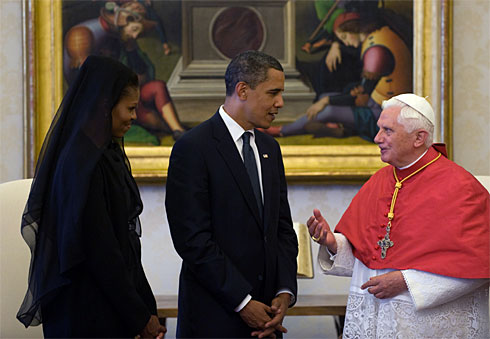
President Obama, a mainline Protestant who currently has no home church, dominated much of the U.S. religion news. His inaugural address called the USA "a nation of Christians and Muslims, Jews and Hindus and non-believers."
In his first months, Obama lifted a Bush administration ban on federal funding for groups that offer abortion information and services abroad and expanded the policy permitting federal funds for embryonic stem cell research.
Scores of Catholic bishops called it a travesty that Notre Dame, a flagship Catholic university, awarded Obama an honorary degree and invited him to deliver the commencement address in May.
In his address at Cairo University in June, Obama told the Muslim world the USA is not at war with Islam. He pledged to ease the way for U.S. Muslims to make charitable donations as their faith requires.
Obama used his Nobel Peace Prize acceptance speech in Oslo to lay out the theology of a just war and the morality of standing for the good in a world where, he said, "evil exists."
U.S. Catholic bishops lobby
Church leaders revved up their fight on "life issues" on key battle fronts — with few clear victories, particularly on gay marriage.
Although it was defeated in New York and Maine, same-sex marriage was legalized in Vermont, New Hampshire and, pending a sign-off by Congress, Washington, D.C. Archbishop of Washington Donald Wuerl told the Washington city council that its approval of gay
Fingerprints of God

National Public Radio correspondent Barbara Bradley Hagerty explores the quest to find actual physical evidence of God in her book, "Fingerprints of God: The Search for the Science of Spirituality." Hagerty spoke about her book as part of Minnesota Public Radio's Broadcast Journalist series.
- listen… [mpr player, 54 minutes 8 seconds]
More U.S. Christians Mix in 'Eastern,' New Age Beliefs

Going to church this Sunday? Look around.
The chances are that one in five of the people there find "spiritual energy" in mountains or trees, and one in six believe in the "evil eye," that certain people can cast curses with a look — beliefs your Christian pastor doesn't preach.
In a Catholic church? Chances are that one in five members believe in reincarnation in a way never taught in catechism class — that you'll be reborn in this world again and again.
Elements of Eastern faiths and New Age thinking have been widely adopted by 65% of U.S. adults, including many who call themselves Protestants and Catholics, according to a survey by the Pew Forum on Religion & Public Life released Wednesday.
Syncretism — mashing up contradictory beliefs like Catholic rocker Madonna's devotion to a Kabbalah-light version of Jewish mysticism — appears on the rise.
And, according to the survey's other major finding, devotion to one clear faith is fading.
Of the 72% of Americans who attend religious services at least once a year (excluding holidays, weddings and funerals), 35% say they attend in multiple places, often hop-scotching across denominations.
They are like President Obama, who currently has no home church. He has worshiped at a Baptist church, an Episcopal one, and the non-denominational chapel at Camp David.
"Mixing and matching practices and beliefs is as much the norm as it is the exception," Pew's Alan Cooperman says. "Are they grazing, sampling, just curious? We really don't know."
Even so, says Pew researcher Greg Smith, "these findings all point toward a spiritual and religious openness — not necessarily a lack of seriousness."
Feeling Lonely? Chances Are You're not Alone.
Loneliness is transmittable, researchers say.
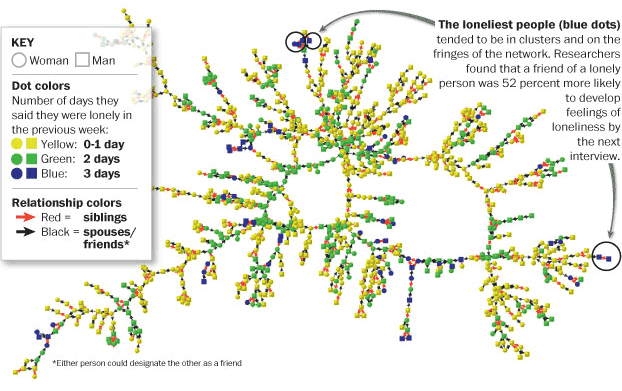
Loneliness is like a disease -- and what's worse, it's contagious.
Although it may sound counterintuitive, loneliness can spread from one person to another, according to research being released Tuesday that underscores the power of one person's emotions to affect friends, family and neighbors.
The federally funded analysis of data collected from more than 4,000 people over 10 years found that lonely people increase the chances that someone they know will start to feel alone, and that the solitary feeling can spread one more degree of separation, causing a friend of a friend or even the sibling of a friend to feel desolate.
"Loneliness can be transmitted," said John T. Cacioppo, a University of Chicago psychologist who led the study being published in the December issue of the
Journal of Personality and Social Psychology. "Loneliness is not just the property of an individual. It can be transmitted across people -- even people you don't have direct contact with."
Moreover, people who become lonely eventually move to the periphery of their social networks, becoming increasingly isolated, which can exacerbate their loneliness and affect social connectedness, the researchers found.
"No man is an island," said Nicholas A. Christakis, a professor of medicine and medical sociology at Harvard Medical School who helped conduct the research. "Something so personal as a person's emotions can have a collective existence and affect the vast fabric of humanity."
The seemingly paradoxical finding is far more than a psychological curiosity. Loneliness has been linked to a variety of medical problems, including depression, sleep problems and generally poorer physical health. Identifying some of the causes could help reduce the emotion and improve health, experts said.
For These 'Spiritual Warriors,' the Casualties Were Real
What would you do for spiritual enlightenment and personal success? Would you agree to spend 36 hours alone in the desert without food or water to help clear your mind and find your true potential? Would you follow a trusted leader into a dark, hot tent to experience a version of a centuries-old Native American sweat lodge ritual? History shows that in the name of self-help, many people will do just that -- and more.
Three people died and more than a dozen others were injured as a result of an Oct. 8 retreat in Sedona, Ariz., led by James Arthur Ray, a nationally known self-help guru. According to interviews with participants and their family members, within hours of returning from a desert "vision quest," and dehydrated from lack of food and water in the previous day and a half, more than 50 people followed Ray into a 20-by-20-foot makeshift sweat lodge of wood, plastic tarps and blankets. It was the surprise culmination of his "Spiritual Warrior" event, for which participants had paid as much as $9,695 per person.
For nearly two hours, Ray sat at the only exit of the small lodge, encouraging the group to "go full-on" and "push past your self-imposed and conditioned borders." Periodically, he brought in glowing red rocks to intensify the heat inside the dark structure, where men and women sat or lay down in meditation. At the ritual's conclusion, seemingly unaware of the bodies of the unconscious lying around him, Ray emerged triumphantly, witnesses said, pumping his fist in the air because he had passed his own endurance test.
Smashing the Idols
Writer Andrew Brown explores the controversial cultural and theological legacy of Calvinism.

Perhaps nobody has ever looked at death, hell, human nature and God quite so uncompromisingly as the lawyer born in Noyon in 1509, who gave his name to one of the fiercest and most influential forms of Protestantism.
John Calvin believed in a world where God controlled all, and who went to heaven and who went to hell was predestined - Christ died for only a select few. Nothing except the Bible was tolerated in church which led to Calvinism's terrible reputation as a destroyer of art.
It is argued that Calvinism influenced many aspects of our modern society - science, economics, philosophy, democracy - but such claims are considered by historians to be overblown. They instead highlight the strangely paradoxical qualities of a faith which fuelled both the religious wars of the 17th century and the enlightenment which followed.
Moving from Geneva to Scotland, and talking to historians Diarmaid MacCulloch and Bill Naphy, as well as novelists Marilynne Robinson and James Robertson, Andrew explores the sometimes unexpected legacies of this extraordinarily polarising system of belief. With works by Calvin read by John Sessions and music by Cappella Nova.
- listen… [85 minutes, mp3 format]
Lab Produces Monkeys with Two Mothers
Research may help women with genetic disorders but raises ethical questions.

Scientists have produced monkeys with genetic material from two mothers, an advance that could help women with some inherited diseases have healthy children but that would raise a host of safety, legal, ethical and social questions if attempted in people.
Using cloning-related techniques, the researchers developed a way to replace most of the genes in the eggs of one rhesus macaque monkey with genes from another monkey. They then fertilized the eggs with sperm, transferred the resulting embryos into animals' wombs and produced four apparently healthy offspring.
The technique was developed for women who have disorders caused by defects in a form of DNA passed only from females to their children, and the researchers said they hope the work will eventually translate into therapies for people.
"We believe this technique can be applied pretty quickly to humans and believe it will work," said Shoukhrat Mitalipov of the Oregon Health & Science University in Portland, who led the work, published online Wednesday by the journal Nature.
Many scientists hailed the research as a technically impressive feat that could help many families rid themselves of a variety of terrible disorders caused by defects in genetic material known as mitochondrial DNA.
"This is of great importance. This approach will be beneficial to many families," said Jan Smeitink, a professor of mitochondrial medicine at Radboud University Nijmegen in the Netherlands.
But the work could also raise thorny ethical and legal issues, including questions surrounding the creation of offspring with DNA from two mothers and a father.
The Obamas Find a Church Home — Away from Home
For the past five months, White House aides and friends of the Obamas have been quietly visiting local churches and vetting the sermons of prospective first ministers in a search for a new — and uncontroversial — church home. Obama has even sampled a few himself, attending services at 19th Street Baptist on the weekend before his inauguration and celebrating Easter at St. John's Episcopal Church.
Now, in an unexpected move, Obama has told White House aides that instead of joining a congregation in Washington, D.C., he will follow in George W. Bush's footsteps and make his primary place of worship Evergreen Chapel, the nondenominational church at Camp David.
A number of factors drove the decision — financial, political, personal — but chief among them was the desire to worship without being on display. Obama was reportedly taken aback by the circus stirred up by his visit to 19th Street Baptist in January. Lines started forming three hours before the morning service, and many longtime members were literally left out in the cold as the church filled with outsiders eager to see the new President. Even at St. John's, which is so accustomed to presidential visitors that it is known as the "Church of the Presidents," worshippers couldn't help themselves from snapping photos of Obama on their camera phones as they walked down the aisle past him to take communion.
The challenge of not only being part of a church community but also praying in peace has long been a problem for Presidents, according to historian Carl Sferrazza Anthony. "McKinley hated having people staring at him while he read Psalms, sang hymns, put money in the collection plate or took communion," he writes in America's First Families. "By the 1920s, getting a presidential family in and out of church was a production. Secret Service agents had to cordon off a clear path from the curb to the church entrance before the Coolidges arrived ... [and] they were swiftly escorted to their third-row pew."
The Clintons attended Foundry United Methodist Church on 16th Street, and were particularly active during the years before Chelsea left for college. But White House aides say that security measures required by the Secret Service have become stricter since 9/11 and would cause significant delays for parishioners — and at significant cost to taxpayers — on Sunday mornings. Given Obama's popularity within the African-American community, the President also worried that if he chose a local black congregation, church members would find themselves competing with sightseers for space in the pews.
Can Science Find God?
An interview with Barbara Bradley Hagerty

For NPR correspondent Barbara Bradley Hagerty, religion is more than just a beat. Hagerty was raised as a Christian Scientist and grew up listening to her grandmother's stories of healing illnesses and serious injuries through prayer. As an adult, Hagerty became a Protestant Christian after experiencing her own encounter with a divine presence, a moment she describes as "spooky." In her new book, Fingerprints of God: The Search for the Science of Spirituality, Hagerty goes on a professional and personal journey to discover whether science can explain religious phenomena like healing or mystical experiences — and ultimately whether it can prove the existence of God.
You were raised Christian Scientist, but this week you're on a bunch of medications for various throat and ear infections. What happened?
It kind of started with Tylenol. I had never taken a pill, never gone to the doctor, but one winter when I was 32 years old, I came down with the flu. I was miserable, shaking, drifting in and out of consciousness. In a lucid moment, I remembered someone had left Tylenol in my medicine cabinet. I pulled the bottle out, took one, and crawled back into bed. (See pictures of spiritual healing around the world.) I had been taught that drugs have no power over your body, that it's all your thinking. But within five minutes the shivering just stopped. It took me about a year to leave Christian Science, but that was the end of my formal faith in it. It turned out not to be the end, however, of how I thought about how thoughts affect the body. (Read TIME's cover story on how faith can heal.)You had a spiritual experience that led to this book as well.
Yes. In the summer of 1995, I was interviewing a woman who was a member of Saddleback Church in California. It was dark and we were sitting outside in a circle of light under a lamppost while she talked to me about her faith. The moment itself is hard to describe. It's as if someone stood on the edge of the circle and was breathing on us. A warm, moist air surrounded us. She was mid-sentence and stopped talking. It was a moment like I hadn't felt before — or since. There was the presence of something else that was spiritual around us. It lasted 30 seconds, maybe a minute, and then it just kind of receded like a wave and was gone. This book really came from that moment, feeling that presence. It was an attempt to find out whether I was crazy or not.That's pretty unusual stuff from an NPR correspondent. Were you hesitant at all to write about this?
Physician-Sikhs Say Army Ban Is Religious Discrimination

Two U.S. Army recruits, who are members of the Sikh faith, have filed a complaint against the Army over rules that require them to cut their hair and beards and forbids them to wear turbans. The Sikhs call it religious discrimination. The Army says it bans overt religious symbols and for practical reasons it cannot accomodates the Sikhs' requirements.
STEVE INSKEEP, host:
A couple of U.S. military recruits who practice the Sikh religion claim that the U.S. Army is violating their constitutional rights. They filed a complaint yesterday, saying the army is forbidding them from wearing their turbans while on active duty. NPR's Barbara Bradley Hagerty reports.
BARBARA BRADLEY HAGERTY: Captain Kamaljeet Kalsi and Second Lieutenant Tejdeep Rattan were both recruited to serve in the U.S. Army - Kalsi as a doctor; Rattan as a dentist. They say at that time they were told that they could wear their turbans and keep their hair unshorn, a symbol of their Sikh religion. Kalsi says Sikhs in general, and his family in particular, have a long history of military service.
Mr. KAMALJEET KALSI (Captain, U.S. Army): And just like my father and my grandfather, my great-grandfather before me, we want to serve with both our uniforms, both our religious and our military uniforms - and we've done with distinction.
BRADLEY HAGERTY: The men are expected to report for active duty soon, but the army has told them that a 1981 policy prohibits personnel from wearing visible symbols of faith. The Army has declined to comment, but Steven Levine, who served as an Army lawyer between 1992 and 1999, says there are two reasons: unit cohesion and military readiness.
Mr. STEVEN LEVINE (Former Army Lawyer): I anticipate the military would argue that the wearing of a turban would interfere with a soldier's ability to put on a gas mask, to wear a Kevlar helmet, to even simply wear a beret.
listen now or download Morning Edition [2 min 32 sec]
- listen… []
Remembering the Meaning of Lent

On days like these, all the songs and poems about spring start popping up in your mind. It's time again for flowers, budding trees and… allergies. Gardeners are on hyperdrive, and churches, sanctuaries, and temples are sprucing up for a week of celebrations. As commentator John Timpane remarks, it is a time for renewing the spirit and and remembering the meaning of lent.
Timpane: Friends always ask his time of year: What's this Lent thing all about? Here's one answer: Remembering.
Most Religious Groups in USA Have Lost Ground, Survey Finds
"More than ever before, people are just making up their own stories of who they are. They say, 'I'm everything. I'm nothing. I believe in myself,' " says Barry Kosmin, survey co-author.
Among the key findings in the 2008 survey:
- So many Americans claim no religion at all (15%, up from 8% in 1990), that this category now outranks every other major U.S. religious group except Catholics and Baptists. In a nation that has long been mostly Christian, "the challenge to Christianity … does not come from other religions but from a rejection of all forms of organized religion," the report concludes.
- Catholic strongholds in New England and the Midwest have faded as immigrants, retirees and young job-seekers have moved to the Sun Belt. While bishops from the Midwest to Massachusetts close down or consolidate historic parishes, those in the South are scrambling to serve increasing numbers of worshipers.
- Baptists, 15.8% of those surveyed, are down from 19.3% in 1990. Mainline Protestant denominations, once socially dominant, have seen sharp declines: The percentage of Methodists, for example, dropped from 8% to 5%.
- The percentage of those who choose a generic label, calling themselves simply Christian, Protestant, non-denominational, evangelical or "born again," was 14.2%, about the same as in 1990.
- Jewish numbers showed a steady decline, from 1.8% in 1990 to 1.2% today. The percentage of Muslims, while still slim, has doubled, from 0.3% to 0.6%. Analysts within both groups suggest those
The Rational Underpinnings of Irrational Anger
"I know how unpopular it is to be seen as helping banks right now, especially when everyone is suffering in part from their bad decisions. I promise you, I get it. But I also know that in a time of crisis, we cannot afford to govern out of anger."
-- President Obama, in his address to Congress last week
William Neilson is mad at all the people who bought homes they could not afford and the bankers who enabled them in order to turn a fast buck. He is mad because he has always paid his mortgage on time and had the common sense not to borrow four times the value of his house. He is mad because, now that the economy is in a tailspin, the president wants honest taxpayers like him who did everything right to lend a hand to help out those who did everything wrong.
Obama's blueprint to lead the country out of recession faces many hurdles, but no challenge may be as great -- or embedded as deeply in the human psyche -- as the visceral distaste many Americans feel about propping up banks and Wall Street "masters of the universe."
In his address to Congress last week, Obama stressed that the point of pouring hundreds of billions of dollars into banks and other financial institutions is not to help bankers but to help ordinary people who depend on banks. If huge banks and other financial institutions collapse as Lehman Brothers did, many economists say, it could send the economy into an even deeper tailspin.
This Is the Way the Culture Wars End
PRESIDENT OBAMA wants to end the culture wars. He recently called for "common ground" on abortion reduction and an end to the "stale and fruitless debate" over family planning. His joint address to Congress this week could be an opportunity to change that debate. But to make a real difference, he'll have to tell two truths that the left and the right don't want to hear: that morality has to be practical, and that practicality requires morals.
Start with abortion. Pro-lifers tend to show up after a woman is pregnant, imagining that laws and preaching will make her bear a child she doesn't want. They're mistaken. Worse, they're too late. To prevent abortions, we have to prevent unintended pregnancies.
How? The conservative answer is abstinence. That's a worthy aspiration. But as a stand-alone national policy for avoiding pregnancies, it's foolish. Mating is the engine of history. It has overpowered every stricture put in its way.
The liberal answer is birth-control availability. In recent years, this has become a second front in the culture wars. Many pharmacists have refused to sell oral contraceptives. In December, President George W. Bush extended that right of refusal to cover other medical professionals unwilling to participate in birth control. Mr. Bush also halted American aid to international family-planning
Science vs Superstition, not Science vs Religion
We are not going to understand the growth of creationism in modern England so long as we think of it as a primarily Christian phenomenon, or even a religious one. Take a look at the most recent surveys of creationist belief among teachers and among the general public. One was conducted by Theos, the Christian thinktank, and has been attacked by the BHA – more of this later – and the other measured attitudes towards creationism among school teachers.
That found that nearly a third of teachers with science as a specialism saw nothing wrong with teaching creationism in class. Now, I have only come across one school where an open attempt was made to do this – the notorious Emmanuel Academy in Gateshead. But the headmaster there told me, and I have no reason to doubt this, that although he was himself an evangelical Christian, the impulse towards creationism in science classes had come from Muslim parents.
So, does this prove that the problem is simply one of religion versus science? Not if the BHA is right about the decline of religious observance. Their most recent press release claims that less than 10% of the British population is religiously observant. But the figures for the rejection of evolution produced in the latest Theos survey completely dwarf the most generous estimates for religious observance.
The Greatest American Innovation in Religion is Tolerance
Watching Obama's inauguration with its repeated invocations of the deity, both formal and informal, it struck me how astonishingly prolific America has been in religious inventions. A short list of religious ideas invented in America would include at the very least religious toleration (from Rhode Island) from the 17th century, the open-air revival meeting (from the Great Awakening) from the 18th, Adventism, and Mormonism, from the 19th century and Pentecostalism and Alcoholics Anonymous from the 20th.
Then there are all the American innovations which are either questionably religious, like worshipping your own constitution or the "free market", or were in some sense pioneered in Europe, like theocratic model settlements. This last also falls into the third category: American religious innovations that were ultimately unsuccessful, along with Christian Science, utopian communes, and, let us hope, scientology.
But the successful American religious innovations have all spread round the world. They have not just become ideas, but transnational cultures bound up with ritual and strengthened by myths about their own history. There has been nothing at any other period of history like that fountain of social invention emerging from one country or civilisation.
Their success is often taken to be an endorsement of the free market in religions: more precisely, it is argued that this is the outcome of consumer choice, as opposed to some nationalised model of religious provision. But to see these belief systems as choices made by rational and autonomous adults is to misunderstand what made them successful and what distinguishes them from the failures.
2 Churches, Black and White, See Hope
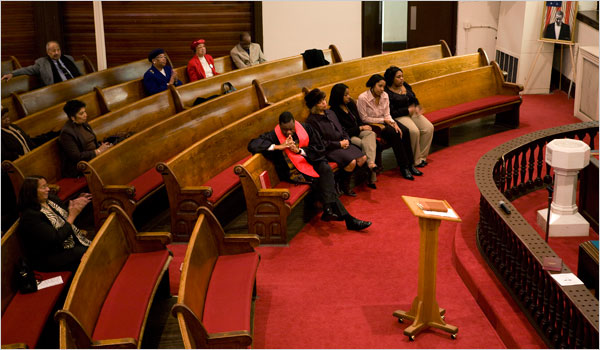
Two Methodist churches have stood on the same block on Capitol Hill for a century, one congregation black and the other white, and in between lies the sorry detritus of a nation’s racial history.
Again and again these congregations have tried to bridge centuries of misunderstanding, only to falter and drift back. This week they will try again, throwing open their doors together to tend to those celebrating the inauguration of the first black president.
"We did not choose but it was chosen for us that we would come together at this moment," said the Rev. Alisa Lasater, the pastor of Capitol Hill United Methodist Church. "If we want to be the heart of our community, we need to learn to see into each others’ heart."
In the voice of these churchgoers can be heard the story of race in the nation’s capital and perhaps in the country itself. There are slights and misunderstandings and reconciliations, with miles traveled and more to go. President-elect Barack Obama spoke to such divisions recently in an interview with ABC News, saying he wanted to find that rare church that spanned Washington’s separate worlds, not least of race.
"You’ve got one part of Washington, which is a company town, all about government, and is generally pretty prosperous," Mr. Obama said. "And then you’ve got another half of D.C. that is going through enormous challenges. "I want to see if we can bring those two Washington, D.C.’s together."
Mr. Obama’s inauguration might offer the nation a new turn, and from that the congregations draw hope. But race’s complications are many, and as these members are reminded daily, they often find themselves speaking from starkly different wells of understanding. The inaugural suggests a nation that, even in unity, experiences history from separate racial vantage points. Once, these two churches were one. In 1829, the white members of Ebenezer Methodist Church cast out their black brethren: You tap your feet too insistently, they said, and sing too loudly. So the blacks walked around the corner and founded Little Ebenezer Church.
Obama Redraws Map Of Religious Voters
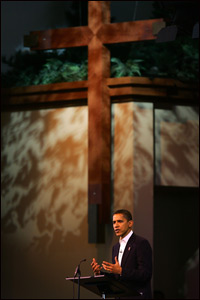
Religious language trips off Barack Obama's tongue as if he were a native of the Bible Belt. From the moment he emerged on the national scene, he has spoken to believers in a language few Democrats have mastered: the language of the Bible and of a personal relationship with God.
Sometimes he shares his adult conversion story, describing how he knelt beneath the cross at his Chicago church: "I felt I heard God's spirit beckoning me," he says. "I submitted myself to his will, and dedicated myself to discovering his truth and carrying out his works."
Sometimes he speaks of sin and personal responsibility: "When a gangbanger shoots indiscriminately into a crowd because he feels someone has disrespected him," he told a group of religious progressives in 2006, "We've got a moral problem. There's a hole in that young man's heart."
And sometimes he borrows code words, not from hymns, but from Christian rock star Michael W. Smith, such as when he proclaimed at the 2004 Democratic National Convention, "We worship an awesome God in the blue states!"
It is this ease with religion that has helped Obama win over voters of various religious stripes — including Catholics who traditionally have voted Republican.
Pollster Robert P. Jones of Public Religion Research says that Obama's appearance at the 2004 convention was a turning point in the relationship between Democrats and believers. Then, a majority of Americans viewed the Democratic Party as hostile to religion. But Jones' poll this month found a remarkable shift.
"Barack Obama was perceived to be more friendly to religion than John McCain," he says. "And that is, I think, an indication of the real sea change that's under way, and the way in which religion is interacting in public life."
listen now or download All Things Considered
- listen… []
America's Paradox:
We want religion in, but out, of politics

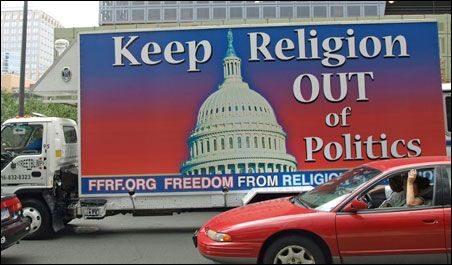
"Keep religion out of politics," said a mega sign cruising St. Paul's streets on the back of a truck on Monday, the opening day of the Republican National Convention.
But a few blocks away, dozens of anti-war demonstrators marched with placards declaring: "Blessed Are the Peacemakers, For They Will Be Called Sons of God."
And Steve Ahlgren's sign said, simply: "1st John 4:7-21."
It was a biblical reference to loving God and loving one another, too. And Ahlgren, a lawyer from Lauderdale, insisted that religion expressed like that has a place in politics as a powerful force for good.
Religion in politics? Religion out of politics?
Two views, same country
Both positions, paradoxically, express the view of America, one of the most devout nations in the Western world.
"Religion plays a crucial role, and it has throughout the history of the Republic," said Dan Hofrenning, a political science professor at St. Olaf College in Northfield.
It was a factor in the moral justification of FDR's New Deal, he said, and it was debated intensely when John F. Kennedy, a Roman Catholic, ran for president. Religion provided moral authority for the civil-rights movement in the 20th century, and it played a role in women's drive for suffrage.
Indeed, religion trumps the issues for many Americans. And voters who perceive a candidate as sharing their own faith and a related set of values will forgive the candidate on a range of issues.
The Next Big Stem Cell Fight: Mixing Cow and Human DNA

In Gary Larson’s wacky Far Side world, cows and humans swap traits with hilarious results.
Nobody is laughing, though, over a real-world bid to mix cow and human DNA, something scientists here say they must do in order to advance stem cell studies.
Debate over this step in the exploration of stem cells already has reverberated across the Atlantic. Sen. Norm Coleman, R-Minn., is a co-sponsor of a bill that would ban the research in the United States.
From the first test-tube baby to the first cloned animal, scientists in this part of the world have led a biological revolution that set off an uproar in the United States but met relative calm here.
Now, though, the research is crossing a line that has shattered the calm and ignited fiery debate all the way up to Prime Minister Gordon Brown’s cabinet.
The line at issue is the notion that the human animal is fundamentally different from all other creatures on Earth—in a sacred sense for many people of many faiths.
"From a Christian viewpoint, the teaching is, of course, that we are made in the image of God, and there is something special about human life in relation to divinity," said Sir Brian Heap, a prominent Cambridge University biologist who has helped his government
Religion is Poetry
The beauties of religion need to be saved from both the true believers and the trendy atheists, argues compelling religious scholar James Carse.


Take a snapshot of the conflicts around the world: Sunnis vs. Shiites, Israelis vs. Palestinians, Serbs vs. Kosovars, Indians vs. Pakistanis. They seem to be driven by religious hatred. It's enough to make you wonder if the animosity would melt away if all religions were suddenly, somehow, to vanish into the ether. But James Carse doesn't see them as religious conflicts at all. To him, they are battles over rival belief systems, which may or may not have religious overtones.
Carse, who's retired from New York University (where he directed the Religious Studies Program for 30 years), is out to rescue religion from both religious fundamentalists and atheists. He worries that today's religious zealots have dragged us into a Second Age of Faith, not unlike the medieval Crusaders. But he's also critical of the new crop of atheists. "What these critics are attacking is not religion, but a hasty caricature of it," he writes in his new book, "The Religious Case Against Belief."
Researchers Say Stonehenge Was a Burial Ground
Conclusion Runs Counter to Long-Held Theories
The secret of Stonehenge has apparently been solved: The mysterious circle of large stones in southern England was primarily a burial ground for almost five centuries, and the site probably holds the remains of a family that long ruled the area, new research concludes.
Based on radiocarbon dating of cremated bones up to 5,000 years old, researchers with the Stonehenge Riverside Project said they are convinced the area was built and then grew as a "domain of the ancestors."
"It's now clear that burials were a major component of Stonehenge in all its main stages," said Mike Parker Pearson, an archaeology professor at the University of Sheffield in England and head of the project. "Stonehenge was a place of burial from its beginning to its zenith in the mid-third millennium B.C."
The finding marks a significant rethinking of Stonehenge. In the past it was believed that some burials took place there for a century but that the site's significance lay in its ceremonial and religious functions, including serving as a center for healing.
A combination of the radiocarbon dating, excavations nearby that have revealed a once-thriving village and the fact that the number of cremated remains appeared to grow over a 500-year period convinced researchers that the site was used for a long time and most likely was a burial ground for one ruling family.
Parker Pearson said the discovery of a mace head -- the enlarged end of a clubbing weapon -- supports the theory that it was the province of a ruling family since it was long a symbol of authority in England and still serves that function in the House of Commons.
Catholics at a Crossroads

It won't be the easiest roadshow for the leader of the world's largest Christian church, a man who many thought would be a quiet but dogmatic transitional figure focused on preserving the church in an increasingly secular Europe. But Pope Benedict XVI has already upset expectations, and when he arrives this month for his first pontifical visit to the United States, many of his admirers believe that he will overturn more.
As Benedict well appreciates, his upcoming six-day visit to Washington and New York City will bring him into direct contact with a nation that has not only the third-largest Roman Catholic population in the world but also the most diverse. In ethnic terms, that variety may be taking on an increasingly Hispanic cast--at almost 30 percent and rapidly growing--but most of America's 195 dioceses can boast of parishes with a mini-United Nations of national flavorings as well as those in which the melting pot has effectively left no particular ethnic imprint at all.
But the diversity of America's Roman Catholic Church hardly ends with ethnicity. It also includes a rainbow of attitudes and convictions--political, social, liturgical, even theological--that reflect American individualism in ways that strain even the universalism of the Catholic Church. It's a tough act to read this audience and even tougher to know how to address it. And it makes it no easier that this pope, a private man known for his formidable intellect and doctrinal rigor, follows in the footsteps of the charismatic and beloved John Paul II.
Which is not to suggest that most American Catholics are ill-disposed toward Benedict. His former sharp-edged image as God's Rottweiler grew out of his years as chief enforcer of doctrine, the Cardinal Joseph Ratzinger who quashed liberation theology or any other departures from strict church teaching. But now completing the third year of his papacy, having penned major encyclicals emphasizing hope and charity, he appears less concerned with policing borders than with gently reminding the flock of core Christian principles. If he remains firmly orthodox in his teaching, it is an "affirmative orthodoxy," in the words of National Catholic Reporter columnist John Allen. "This has been a far more moderate, gradualist pontificate than most people anticipated," Allen says. And as polls have shown, a large majority of American Catholics say they approve of the German-born prelate, who will turn 81 on his U.S. visit.
The Faith of Flanders

No one would mistake Ned Flanders, the goofy next-door neighbor in "The Simpsons," for a polished televangelist like Joel Osteen. But over the past two decades the zealous cartoon character has become one of the best-known evangelicals on America's small screen. With Americans spending exponentially more time on their sofas watching television than in pews listening to sermons, this is no insignificant matter.
In the inevitably intertwined world of religion and commerce, it's only natural that the man portrayed as "Blessed Ned of Springfield" on the cover of Christianity Today magazine should have his own "new testament." And so he does. "Flanders' Book of Faith," by "Simpsons" creator Matt Groening, is a slim, illustrated entry in the show's "Library of Wisdom" series.
For years, the TV show's writers, fiercely protective of their reputation for irreverence, denied that they were in any way sympathetic toward sincere belief, as embodied by the Flanders character. But releasing the book under Mr. Groening's name puts an imprimatur on that kind-to-religion interpretation, long held in younger evangelical circles.
A fundamentally decent true believer, Ned is firmly in the theological tradition of Mr. Osteen, Robert Schuller and Norman Vincent Peale in at least one respect. He, too, is an irrepressible apostle of optimism. The only time his faith has been shaken, and then only briefly, came in 2000 when his wife, Maude, was killed in a freak accident (following a real-life pay dispute between the show's producers and the actress who supplied Maude's voice). As his neighbor Homer Simpson puts it during one service at Springfield Community Church: "If everyone here were like Ned Flanders, there'd be no need for heaven. We'd already be there."
A Fiery Theology Under Fire
Black liberation theology was a radical movement born of a competitive time.
By the mid-1960s, the horns of Jericho seemed about to sound for the traditional black church in the United States. Martin Luther King Jr. was yielding to Malcolm X. Young black preachers embraced the Nation of Islam and black intellectuals sought warmth in the secular and Marxist-tinged fire of the black power movement.
As a young, black and decidedly liberal theologian, James H. Cone saw his faith imperiled.
"Christianity was seen as the white man’s religion," he said. "I wanted to say: ‘No! The Christian Gospel is not the white man’s religion. It is a religion of liberation, a religion that says God created all people to be free.’ But I realized that for black people to be free, they must first love their blackness."
Dr. Cone, a founding father of black liberation theology, allowed himself a chuckle. "You might say we took our Christianity from Martin and our emphasis on blackness from Malcolm," he said.
Black liberation theology was, in a sense, a brilliant flanking maneuver. For a black audience, its theology spoke to the centrality of the slave and segregation experience, arguing that God had a special place in his heart for the black oppressed. These theologians held that liberation should come on earth rather than in the hereafter, and demanded that black pastors speak as prophetic militants, critiquing the nation’s white-run social structures.
Black liberation theology "gives special privilege to the oppressed," said Gary Dorrien, a professor of social ethics at Union Theological Seminary in New York. "God is seen as a partisan, liberating force who gives special privilege to the poorest."
Does Wright Represent Black Church-Goers?
Two leading experts share their diverging views
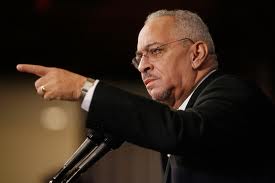
The recent comments of Rev. Jeremiah Wright have not only complicated the presidential campaign of Senator Barack Obama, who for more than 20 years has been a member of the Trinity United Church of Christ that Wright once pastored. Some of Wright's remarks—particularly his claim that criticism of his more provocative sermons "is not an on attack on Jeremiah Wright" but instead "an attack on the black church"—have also sparked wide a debate on whether Wright typifies the beliefs of millions of African-American churchgoers and their ministers. U. S. News approached two leading experts on the African-American church figures with a single question: "How well does Rev. Jeremiah Wright represent the black church in America?" Here are their answers:
Dwight Hopkins is a professor at the University of Chicago Divinity School and the author of Heart and Head: Black Theology Past, Present, and Future and many other books.
"I think his theology and his religious perspective are both very representative, especially linking the personal salvation with social justice critique. In fact, those two focii have been the hallmark of the black church in America since the black church was founded in the period of slavery. But unfortunately what has happened, particularly in the past seven and a half years, is that President Bush has promoted a small group of black clergy to represent all of black Christianity. He's promoted a theological trend called "prosperity gospel" which is basically that individuals should use Jesus Christ plus capitalism to get personally rich.
But the contribution the black church made during the period of slavery in this country was linking personal salvation with social critique of public policy—the government's public policy on slavery. Of course people have questions about the form of Wright's presentation but the substance and tradition that he practices both link back with the church that they were founded on."
Scientists Poised to Create Life
Researchers say they are one step away from first man-made organism.

Like cooks whipping up a recipe from scratch, a team of genetics researchers has artificially assembled all of the genes needed to make a simple bacterium, in hopes of creating a synthetic organism by the end of the year.
The team led by maverick scientist J. Craig Venter chose the smallest target possible by building the genome of Mycoplasma genitalium, one of the tiniest known species of bacteria. But they have much larger ambitions, such as understanding the most basic requirements for life and designing new bacterial life-forms capable of producing biofuels.
"If the experiments are successful, we could enter into a new design phase of biology," Venter said Thursday during a press teleconference from Davos, Switzerland.
Despite such lofty goals, the new study published online in the journal Science does not demonstrate godlike control over life.
The team has tried but failed to insert the genes into a bacterial cell and"reboot" the cell into a new, living organism. Venter’s colleagues said theyare hard at work on the problem, which is complicated by cellular compoundsthat can break down DNA before it takes hold.
So far, the researchers have been able to string together a copy of the 582,970 chemical components in the existing bacterium’s DNA. The copy is perfect, except it disrupts a gene necessary for the bacteria to infect people and contains genetic "watermarks" the group
Here's Hoping....
.... for Charles Darwin's spirit
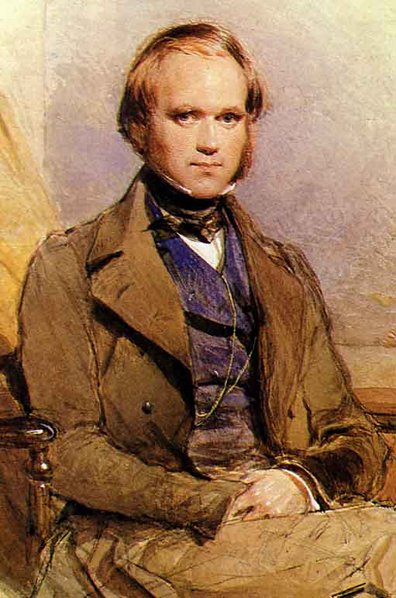
Of course, Charles Darwin can't come back to life. But somehow I wish his open-minded spirit and dogged intellectual honesty could visit our 2008 political arena where the question of how we humans got our origins will, once again, divide America.
Full disclosure: The editors asked me to write about my greatest wish for next year. This isn't my greatest wish, given wars raging around the world and many other reasons to worry about my children's future. But I've wanted to write this piece ever since I had a chance last summer to view Darwin's papers at the University of Cambridge in England.
Schooled by clerics, Darwin wrestled with faith in an omniscient creator even while he stretched his mental horizons to ponder evidence that mysteries of Earth's intricate life could be explained by a scientific theory.
"I am in an utterly hopeless muddle," Darwin wrote to his friend Asa Gray in November, 1860. "I cannot think that the world, as we see it is the result of chance; & yet I cannot look at each separate thing as the result of Design."
That muddle is central to my wish. It isn't easy to open the mind and think creatively about America 2008, its urgent needs and its role in the world. Such thinking requires the humility to drop partisan defenses and listen to the other side. It demands attention to the details of national policy at a time when the overwhelming preferences are entertainment and shopping.
Darwin did it and came up with a theory that gives a common thread to all life on earth — the lives of Christians and Muslims, Hutus and Tutsis, lowly microbes and astrophysicists.
Is Great Happiness Too Much of a Good Thing?
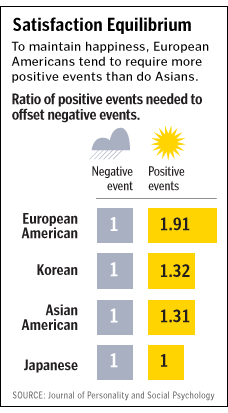
Ten years ago, Harry Lewenstein was riding a bike down a hill in southern Portugal when he hit a bump without warning. The 70-year-old retired electronics executive was going fast, and the shock propelled him clear over the handlebars.
When his wife and friends rushed up, they found him flat on his back. Sensing that he might have spinal cord damage, one friend poked his foot with a sharp object, and then slowly moved up his body. Lewenstein felt nothing until his friend poked his upper chest.
Back at his home in California, it became clear that the injury had permanently deprived Lewenstein of all control over his legs. He had limited use of his arms but could not pick anything up with his hands. His fingers were rigidly curled.
Now 80, Lewenstein has outlived many predictions of his death, but that is not the most remarkable thing about him: He has spent no time, he says, feeling sorry for himself or regretting the accident. He knows he was riding the bike faster than he should have. And each day, he discovers new ways to be resourceful with what he does have -- and new reasons to feel grateful.
"Some people feel sorry for themselves or mad at the world," he said. "I did not . . . after I was injured, I was so totally incapacitated and so much out of everything that every day turned out to be a positive day. Each day, I recovered a little more of my memory, of my ability to comprehend things."
Lewenstein's story is especially instructive in light of a study published this week about a paradox involving happiness. Americans report being generally happier than people from, say, Japan or Korea, but it turns out that, partly as a result, they are less likely to feel good when positive things happen and more likely to feel bad when negative things befall them.
Put another way, a hidden price of being happier on average is that you put your short-term contentment at risk, because being happy raises your expectations about being happy. When good things happen, they don't count for much because they are what you expect. When bad things happen, you temporarily feel terrible, because you've gotten used to being happy.
"I have some friends who are very well off and have great lives," said Sonja Lyubomirsky, a psychologist at the University of California at Riverside. "If you ask them, they will say, 'I am very happy,' but the most minor negative events will make them unhappy. If they are traveling first class, they get upset if they have to wait in line. They live in a mansion, but
The Face of Islam in America
HARTFORD, Conn. — Ingrid Mattson knows the media drill well.
She has done the "We condemn … (fill in the terrorism incident)" speeches — as if, she says, that's all anyone needs to hear from the president of the Islamic Society of North America (ISNA).
She has done the profiles of her as first woman/first convert/first North American-born head of the continent's largest Muslim group.
She has done the talk shows retelling how 20 years ago, she left the Catholicism of her Canadian childhood and her college focus on philosophy and fine arts to find her spiritual home in Islam.
"It's time now to move the focus back off me and back on the issues," says Mattson, a professor at Hartford Seminary, where she directs the first U.S.-accredited Muslim chaplaincy program at the Macdonald Center.
Mattson begins the second half of her two-year term at the society's Labor Day weekend national conference outside Chicago. The annual event draws 40,000 Muslims of every sect, culture, age, race and ethnicity for scores of sessions on faith, family and society and a massive multicultural bazaar.
But two weeks before the conference, sitting with two women in her tiny, book-stuffed office, Mattson has a moment to kick off her shoes. She sheds the long brown jacket stifling her tailored blue blouse, leans back and talks about her vision of American Muslim life
Meta Physicists

As though their knowledge of the quantum secrets came with the power of prophecy, some three dozen of Europe’s best physicists ended their 1932 meeting in Copenhagen with a parody of Goethe’s "Faust." Just weeks earlier, James Chadwick had discovered neutrons — the bullets of nuclear fission — and before long Enrico Fermi was shooting them at uranium atoms. By the time of the first nuclear explosion a little more than a decade later in New Mexico, the idea of physics as a Faustian bargain was to its makers already a cliché. Robert Oppenheimer, looking for a sound bite, quoted Vishnu instead: "Now I am become Death, the destroyer of worlds."
Innocent of all that lay before them, the luminaries gathering at Niels Bohr’s Institute for Theoretical Physics were in a whimsical mood. Werner Heisenberg, Paul Dirac and Lise Meitner were there. Max Delbrück, the young scientist charged with writing the spoof — it happened to be the centennial of Goethe’s death — couldn’t resist depicting Bohr himself as the Lord Almighty and the acerbic Wolfgang Pauli as Mephistopheles.
They were perfect choices. The avuncular Bohr, with his inquisitive needling, had presided over the quantum revolution, revealing the strange workings within atoms, while the skeptical Pauli, who famously signed his letters "The Scourge of God," could always be counted on for a sarcastic comment. ("What Professor Einstein has just said is not so stupid.") Faust, who in the legend sells his soul for universal knowledge, was recast as a troubled Paul Ehrenfest, the Austrian physicist who despaired of ever understanding this young man’s game in which particles were just smears of probability.
Evangelical May Be Up for Grabs
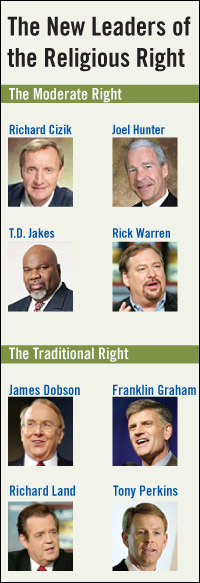
The death of the Rev. Jerry Falwell marks a changing of the guard for religious conservatives that has been under way for several years.
In the 1980s, Falwell mobilized millions of evangelicals. But today, younger Christians are becoming restive with the old style and focus. In fact, some pollsters say that more than 40 percent of white evangelical voters could be up for grabs in the 2008 election.
Beyond the Wedge Issues
Two months before he died, Falwell gave a televised sermon about global warming. It was vintage Falwell: grand, pugnacious and, he admitted, politically incorrect. Falwell said that the danger to society is not global warming, but the green movement itself. He worried particularly about evangelicals involved in the green movement: They were being distracted from moral concerns, such as abortion, gay marriage, violence and divorce.
"It is Satan's attempt to redirect the church's primary focus," Falwell said in March to his 22,000-person-strong congregation at the Thomas Road Baptist Church in Lynchburg, Va.
"I'm telling these guys they need to get off that kick," Falwell said, "because the idea is to divert your energies from the message and the mission and the vision of the church, to something less."
But change is afoot in the evangelical world. Comments from high-profile evangelical leaders like Falwell, Pat Robertson and James Dobson are no longer taken as gospel truth.
To get an idea of how far some evangelicals have traveled since Falwell's heyday, I visited Joel Hunter at his mega-church in Orlando, Fla. Hunter's vision of the "correct" evangelical view of the environment seems to come from a different continent — or a different God.
"Let me tell you one of the reasons I'm so keen on taking care of the environment," he told his 7,700-member church recently. "It's not just that it's beautiful, which it is. But it's the first order we had when we got put into the garden: Cultivate it and keep it."
Hunter is a new kind of evangelical: conservative about abortion and gay marriage, but also engaged in other issues, such as the environment. And he's leading his conservative flock in the same direction.
A Focus on the 'Compassion Issues'
On a recent Saturday morning, I arrived before 7 a.m. at Northland church. The "creation care" team was already assembled and zipping themselves into white HAZMAT suits. The nine church members would spend the next five hours sorting through a week's worth of rubbish generated by the church, picking through diapers, coffee filters, aluminum cans and the occasional pizza crust.
"If we want to reduce the church's waste stream, we have to know what's in it, and there's only one way of doing that," explained church member Raymond Randall as he pulled on white surgical gloves. "So we divide the trash into different parts of the church where it's generated, and then sort it into 35 different categories," such as paper, plastic and glass. The group then sorted through the smelly debris, looking for ways to reduce waste.
This is called "creation care," Randall told me — and it comes straight from the Bible.
listen now or download All Things Considered
- listen… []
When Seeing Is Disbelieving
Four years ago tomorrow, President Bush landed on the USS Abraham Lincoln and dramatically strode onto the deck in a flight suit, a crash helmet tucked under one arm. Even without the giant banner that hung from the ship's tower, the president's message about the progress of the war in Iraq was unmistakable: mission accomplished.
Bush is not the first president to have convinced himself that something he wanted to believe was, in fact, true. As Columbia University political scientist Robert Jervis once noted, Ronald Reagan convinced himself that he was not trading arms for hostages in Iran, Bill Clinton convinced himself that the donors he had invited to stay overnight at the White House were really his friends, and Richard M. Nixon sincerely believed that his version of Watergate events was accurate.
Harry S. Truman apparently convinced himself that the use of the atomic bomb against Japan in the fading days of World War II could spare women and children: "I have told Sec. of War to use [the atomic bomb] so that military objectives and soldiers and sailors
What Americans Don't Know about Religion Could Fill a Book
With roughly 9 in 10 of its citizens claiming to believe in a Supreme Being, America is widely acknowledged to be the most religious of modern industrial nations. Yet when it comes to knowledge about religion, it ranks among the most ill-informed.
With roughly 9 in 10 of its citizens claiming to believe in God or a Supreme Being, America is widely acknowledged to be the most religious of modern industrial nations. Yet when it comes to knowledge about religion, it ranks among the most ill-informed. While close to two thirds of all Americans regard the Bible as a source of answers to life's questions, only half can name even one of the New Testament Gospels. Similarly, in a land of growing religious diversity, only 10 percent of U.S. teenagers can name the world's five major religions. Stephen Prothero, the head of the department of religion at Boston University, calls this condition a "major civic problem." His new book, Religious Literacy, tells how we got here—and how we might do better.
Were we once a religiously literate nation?
Very much so. Religious literacy and basic literacy used to go hand in hand. The Bible was the first reader of the colonists and early Americans, so as they learned to read, they read the Bible. One important sign of this literacy was that Americans conducted many of their most important civic debates, including the debate over slavery, largely in biblical terms.
You name six links in the chain of religious education that once made Americans knowledgeable about religion. What were these, and how were one or two of them weakened, if not demolished?
The big links were churches, schools, households, Sunday schools, colleges, and Bible and tract societies. In schools, the chain of memory got broken not in the '60s by secularists, as many conservative Christians claim, or by Supreme Court rulings that outlawed devotional Bible reading and prayers in public schools. Bible courses and the teaching of religion started to go away in the mid-19th century as a result of the debate over which Bible to read—and that was instigated by religious people, not secularists.
Americans Get an “F” in Religion

Sometimes dumb sounds cute: Sixty percent of Americans can’t name five of the Ten Commandments, and 50% of high school seniors think Sodom and Gomorrah were married.
Stephen Prothero, chairman of the religion department at Boston University, isn’t laughing. Americans’ deep ignorance of world religions—their own, their neighbors’ or the combatants in Iraq, Darfur or Kashmir—is dangerous, he says.
His new book, Religious Literacy: What Every American Needs to Know—and Doesn’t, argues that everyone needs to grasp Bible basics, as well as the core beliefs, stories, symbols and heroes of other faiths.
Belief is not his business, says Prothero, who grew up Episcopalian and now says he’s a spiritually "confused Christian." He says his argument is for empowered citizenship.
"More and more of our national and international questions are religiously inflected," he says, citing President Bush’s speeches laden with biblical references and the furor when the first Muslim member of Congress chose to be sworn in with his right hand on Thomas Jefferson’s Quran.
"If you think Sunni and Shia are the same because they’re both Muslim, and you’ve been told Islam is about peace, you won’t understand what’s happening in Iraq. If you get into an argument about gay rights or capital punishment and someone claims to quote
Raising Spirits to Combat Alchoholism

The study, published in Alcoholism: Clinical and Experimental Research, found their treatment also costs 30% less than conventional cognitive behavioural therapy. According to lead researcher Dr. Keith Humphreys, based at Stanford University, this is because it requires fewer hospital visits and admissions. Up to 80% of alcohol dependent patients start drinking again within six months of a hospital detox.
So why do AA members have a better chance than average?
Dr Humphreys told the BBC's Health Check programme that many AA members point to the spiritual component of their 12-step programme as crucial in fighting the urge to drink.
All faiths
Its non-doctrinal approach means people of all faiths—or no faith—can benefit.
Dr Humphreys said: "It used to be accepted dogma that there would never be a 12-step group in an Islamic country. But today I would bet that it is Brazil and Iran where 12-step groups are growing the fastest."
Last year a group of Iraqi clerics visited Britain, where Professor Sadar Sadiq, the country's National Advisor on Mental Health works as a practicing psychiatrist, to study approaches to alcohol treatment at first hand. "They attended AA meetings and would like to implement it in Iraq," said Professor Sadiq. "But with the conflict and lack of security our progress is very slow."
When Empires Collide
In one of Aesop's Fables a stag takes refuge on a cliff to escape his hunters. He feels safe as long as he can survey the landscape below him. But a boatload of hunters coming upriver spot his silhouette against the sky and bring him down from his blind side. The Holy Roman Emperor Leopold I (1640-1705) resembled that unfortunate stag. He was so fixated on the threat from France and the aggressive designs of Louis XIV that he underestimated a far worse menace from the East. That, combined with his legendary procrastination, almost cost him Vienna and his empire.
In 1683, the Ottoman Turks under Mehmed IV, still smarting from the failure of Suleiman the Magnificent to take Vienna in 1529, began preparing for a new assault on the ultimate prize. Victory, which lay almost within their grasp, would have spelled the end of the Holy Roman Empire. The heartland of Europe would have become yet another unruly Ottoman province.
In his splendid study The Siege of Vienna, the Oxford historian John Stoye provides a detailed account of the intricate machinations, involving a bewildering cast of characters, that led up to this near-debacle. For this was not simply a contest between the Habsburgs and the Ottomans but a quarrel among a host of nations and factions -- Hungarians, Serbs, Poles, Tartars and others -- each of which had its own vital interests and strategic agendas at stake.
Survival of the Fittest: Like Animals, Humans Are Biased

In a world of survival of the fittest, it makes sense that animals are hard-wired with a basic instinct that has them making snap judgments about their predators.
Some chimpanzees attack chimps that are of the same species, but not a part of their group. And some fish attack their own kind simply because they weren't hatched in the same lake.
But what about human beings?
Psychologists say we categorize -- or stereotype -- by age and race and gender, because our brains are wired to do so automatically.
"When you're a social animal, you need to be able to distinguish who's a friend and who's a foe. You need to understand who's a member of your pack, who's a member of a different pack," said John Dovidio, a professor of psychology at the University of Connecticut.
According to Dovidio, even those of us who believe that we don't stereotype, do. "We categorize people automatically, unconsciously, immediately, based on a person's race and based on a person's sex."
When Does It Start?
It begins in childhood. "20/20" brought together three groups of kids and showed them pictures of two men -- one Arab, the other Asian.
When we asked the children which man they liked better, over and over, more kids said they preferred "the Chinese guy."
One child preferred the Chinese man "because he looks nicer and he has a smile on." But both men were smiling.
Several children weighed in on the Arab man's personality, basing their opinions on just seeing his picture. One child said, "I think he's weird." Another child said, "He's like the scary dude."
Next, "20/20" showed the kids pictures of a black man and white man. This time the pictures were different. Here were some of the comments the kids made about the photo of the black man.
One said, "He looks mean." Another referred to him as "FBI's Most Wanted." Another commented, "He looks like he's a basketball player."
When the white man's picture was shown, one child said, "He's nice." Another said, "I think he's nice except he might be mad about something."
The boy was probably picking up on something. The photo of a white man was of Oklahoma City bomber Timothy McVeigh. Admittedly, the pictures were a little bit different, but when we asked which man is a criminal, most kids pointed to the black man. When we asked which man was a teacher, most pointed to McVeigh. This is ironic because the black man pictured was Harvard University professor Roland Fryer.
Most adults claim they don't have these biases, but psychologists who study stereotypes say they do.
The Venomous Media Voices Who Think No Muslim is Worth Talking To
As government efforts to “tackle” extremism flounder, it should beware the advice of armchair warriors and fantasists
One could almost feel sorry for them. A minister like Ruth Kelly is wrenched from her bucket-and spade holiday on a rainy British beach with the kids to launch yet another push to "engage" with Muslims and to step up efforts to "tackle" extremism. A ministerial tour of nine cities to meet Muslims is announced.
It's all designed to sound energetic and purposeful. We pay fat cabinet salaries and we want our politicians to sound like they are earning them. But in truth, beneath the rhetoric—an odd verbal combination of rugby tackles and romantic engagement—is a profound confusion in government policy as to what to do about British-grown Islamist terrorism, apart from large amounts of surveillance and frequent use of detention. Beyond that, the hearts-and-minds strategy is running on empty.
I've seen government ministers do "engagement": Paul Murphy, when he had the community-cohesion brief, listened carefully, answered questions patiently and got precisely nowhere. His young, angry Muslim audience heard him out but were profoundly cynical; their views didn't change a jot.
Events of the last few days will have immeasurably increased that cynicism: Muslim MPs and peers have been roundly ticked off by a succession of government ministers as if they were imperial vassals who should know their place. Yet they were simply stating the obvious—that British foreign policy is incubating (we can argue whether it's the root cause another time) Muslim extremism. Given that kind of opening salvo from her colleagues, perhaps Kelly should save herself the trouble and return to the beach for some more sandcastles and rock pools.
While she's there, the best thing she can do is to get a bit of perspective on a worn-out policy. Even more importantly, she would do well to take stock of a pernicious media onslaught in danger of spiralling out of control. The ministerial tours, the meetings with selected Muslims—most of whom are as baffled by Islamic extremism as ministers—were the responses to last summer's London bombings. The danger is that as the government's "community cohesion" policy flounders, there is no shortage of media commentators pouring out a flood of venomous advice on exactly why no Muslim is worth talking to anyway.
Q&A
Question & answer session with John Timpane, associate editor of The Inquirer Editorial Board, editor of Currents, and author of this week's lead piece in Currents.
So you want us to be mindful of all the connections we’re making, and to think and act ethically regarding them?
- John Timpane
-
Yep.
- The Philadelphia Inquirer
-
Sounds like a lot of work. Why do I have to think about all this? It’s going to slow me down. This sounds all very idealistic and all, but people probably aren’t going to do it. It’ll slow them down too much.
- John Timpane
-
Maybe not as much as you think. It’s more of a shift in attitude. It could actually help you make better decisions—better connections, more useful to you, more productive, more human. And remember, I don’t want anyone to be serious 100 percent of the time. One of my "Commandments of Consciousness" is, after all, "play."
- The Philadelphia Inquirer
-
OK, show me how this could work with, say, e-mail.
- John Timpane
-
Any ethical rule you’d observe in treating people, you’d observe in your connections. You’d keep the other person in mind. E-mail
Forgive and Forget: Maybe Easier Said Than Done
When Lay was found guilty of conspiracy and fraud, Molinell cheered. Then, last Wednesday, before Lay could be sentenced to prison, he died.
"I feel cheated that he didn’t have to do some sort of suffering," said Molinell, 63, of Longwood, Fla. "Even last year, he rented a yacht for his wife’s birthday to the tune of $200,000. For a birthday party!"
"I can speak for a lot of ex-employees and retirees," she added. "It is almost like he got away with something again."
Lay’s death has uncovered a world of hurt and anger among many victims of Houston-based Enron’s demise. And it brings to the fore an unusual challenge for those interested in the psychological nature of pain and forgiveness: What happens to victims when wrongdoers die before they are punished?
Going Beyond God
Historian and former nun Karen Armstrong says the afterlife is a “red herring,” hating religion is a pathology and that many Westerners cling to infantile ideas of God.

Karen Armstrong is a one-woman publishing industry, the author of nearly 20 books on religion. When her breakthrough book "A History of God" appeared in 1993, this British writer quickly became known as one of the world's leading historians of spiritual matters. Her work displays a wide-ranging knowledge of religious traditions–from the monotheistic religions to Buddhism. What's most remarkable is how she carved out this career for herself after rejecting a life in the church.
At 17, Armstrong became a Catholic nun. She left the convent after seven years of torment. "I had failed to make a gift of myself to God," she wrote in her recent memoir, The Spiral Staircase. While she despaired over never managing to feel the presence of God, Armstrong also bristled at the restrictive life imposed by the convent, which she described in her first book, Through the Narrow Gate. When she left in 1969, she had never heard of the Beatles or the Vietnam War, and she'd lost her faith in God.Armstrong went on to work in British television, where she became a well-known secular commentator on religion. Then something strange happened. After a TV project fell apart, she rediscovered religion while working on two books, A History of God and a biography of Mohammed. Her study of sacred texts finally gave her the appreciation of religion she had longed for–not religion as a system of belief, but as a gateway into a world of mystery and the ineffable. Muhammad: A Biography of the Prophet also made her one of Europe's most prominent defenders of Islam.
Armstrong now calls herself a "freelance monotheist." It's easy to understand her appeal in today's world of spiritual seekers. As an ex-nun, she resonates with people who've fallen out with organized religion. Armstrong has little patience for literal readings of the Bible, but argues that sacred texts yield profound insights if we read them as myth and poetry. She's especially drawn to the mystical tradition, which–in her view–has often been distorted by institutionalized religion. While her books have made her enormously popular, it isn't surprising that she's also managed to raise the ire of both Christian fundamentalists and atheists.
Life after Roe
For the first time in 14 years, legal abortion in the United States is in serious jeopardy.
In recent days, the shape of this assault has become clear. First, on the morning of Justice Samuel Alito Jr.’s debut, the Supreme Court announced that it would review the constitutionality of the Partial-Birth Abortion Ban Act, setting up what anti-abortion activists hope will be the beginning of the end of Roe v. Wade . The next day, South Dakota lawmakers passed a ban on virtually all abortions, and abortion rights groups vowed to litigate it all the way to the high court, which would force the justices either to overturn or reaffirm Roe. A few days later, the court told the abortion rights side it could no longer use racketeering laws to halt blockades and protests at abortion clinics.
The impending legal battles put us on the verge of repeating the last two decades of the abortion war: anti-abortion victory, abortion rights backlash. At the end of the cycle 20 years from now, we’ll be right back where we are today. Unless, that is, we find a way out.
Christian Leaders Balk at Robertson's Remarks
The Israeli government has taken the unusual step of cutting all ties with an American preacher, the television evangelist Pat Robertson. The move came after Robertson's comments last week about the massive stroke suffered by Israeli Prime Minister Ariel Sharon, who remains gravely ill. Robertson has been working to set up a massive Christian tourism center in Israel, and that deal is now in question. Robertson's statement is the latest in a string of pronouncements that have left Robertson isolated from other conservative Christians.
Robertson has told viewers of his television show, The 700 Club, that he personally likes Ariel Sharon. In fact, Robertson said he's even prayed with him. But the preacher said Sharon made a mistake when he pulled out of the Gaza Strip, and so, he implied, no one should be surprised that Sharon fell ill.
"Here he's at the point of death," Robertson told viewers in early January, "he was dividing God's land. And I would say, woe unto any prime minister of Israel who takes a similar course to appease the E.U., the United Nations or the United States of America. God says, 'This land belongs to me. You better leave it alone.' " Today, Robertson apologized, but the damage was done for some Christian leaders.
"I was appalled," says Richard Land, president of the Southern Baptist Convention's ethics and religious liberty commission. Besides the insensitivity, Land says, this is bad theology. Saint Paul himself wrote that "God's judgments are unsearchable." When Robertson connects Sharon's stroke with God's judgment, "he's way beyond his theological pay grade," Land says. "That's assuming the prerogatives of God and it betrays both an appalling spiritual ignorance and an appalling spiritual arrogance."
Those are tough words from an evangelical leader who long fought on the same side as Robertson in the culture wars. In fact, not so long ago, Robertson was swimming in the conservative evangelical mainstream. When he ran for the Republican nomination for president in 1988, he energized evangelicals who had never entered politics.
For a segment of people worried about the country's moral direction, candidate Robertson offered a vision of moral — that is, Christian — certainty. "As a people," Robertson said in a campaign speech in 1988, "we believe our freedoms, our liberties, and our wealth were gifts of almighty God, and we must establish faith in God as our no. 1 priority."
listen now or download All Things Considered
- listen… [link to story at www.npr.org]
Enigmatic
The Man Who Knew Too Much: Alan Turing and the Invention of the Computer, by David Leavitt
Maybe it's because I already knew the story - about the tragic genius who revolutionized mathematics, helped the British crack secret Nazi codes and died after biting into a poisoned apple. Or maybe I was just in the mood for fiction. For some reason, about halfway through David Leavitt's short, readable life of Alan Turing, I put the book aside for a few days and turned instead to his most recent novel, "The Body of Jonah Boyd." It is actually a novel within a novel, ending with a self-referential twist that made me wonder whether Leavitt had been inspired by Turing's dizzying proof about undecidability in mathematics, in which a computer tries to swallow its own tail.
Turing was a fellow at King's College, Cambridge, in 1936, when he confronted what might be called the mathematician's nightmare: the possibility of blindly devoting your life to what, unbeknownst to anyone but God, is an unsolvable problem. If only there were a way to know beforehand, a procedure for sifting out and discarding the uncrackable nuts.
Turing's stroke of genius was to recast the issue - mathematicians call it the decision problem - in mechanical terms. A theorem and the instructions for proving it, he realized, could be thought of as input for a machine. If there was a solution, Turing's imaginary device would eventually come to a stop and print the answer. Otherwise it would grind away forever. Although it was not his primary intention, he had discovered, in passing, the idea of the programmable computer.
Now all that he needed to identify undecidable problems was a method for predicting in advance which programs would get stuck in infinite loops. But that would require examining them with another program, and how would you know that it wouldn't get stuck without vetting it with a third program, ad infinitum? Like a novel about a novelist writing a novel, the dream of mathematical infallibility went